
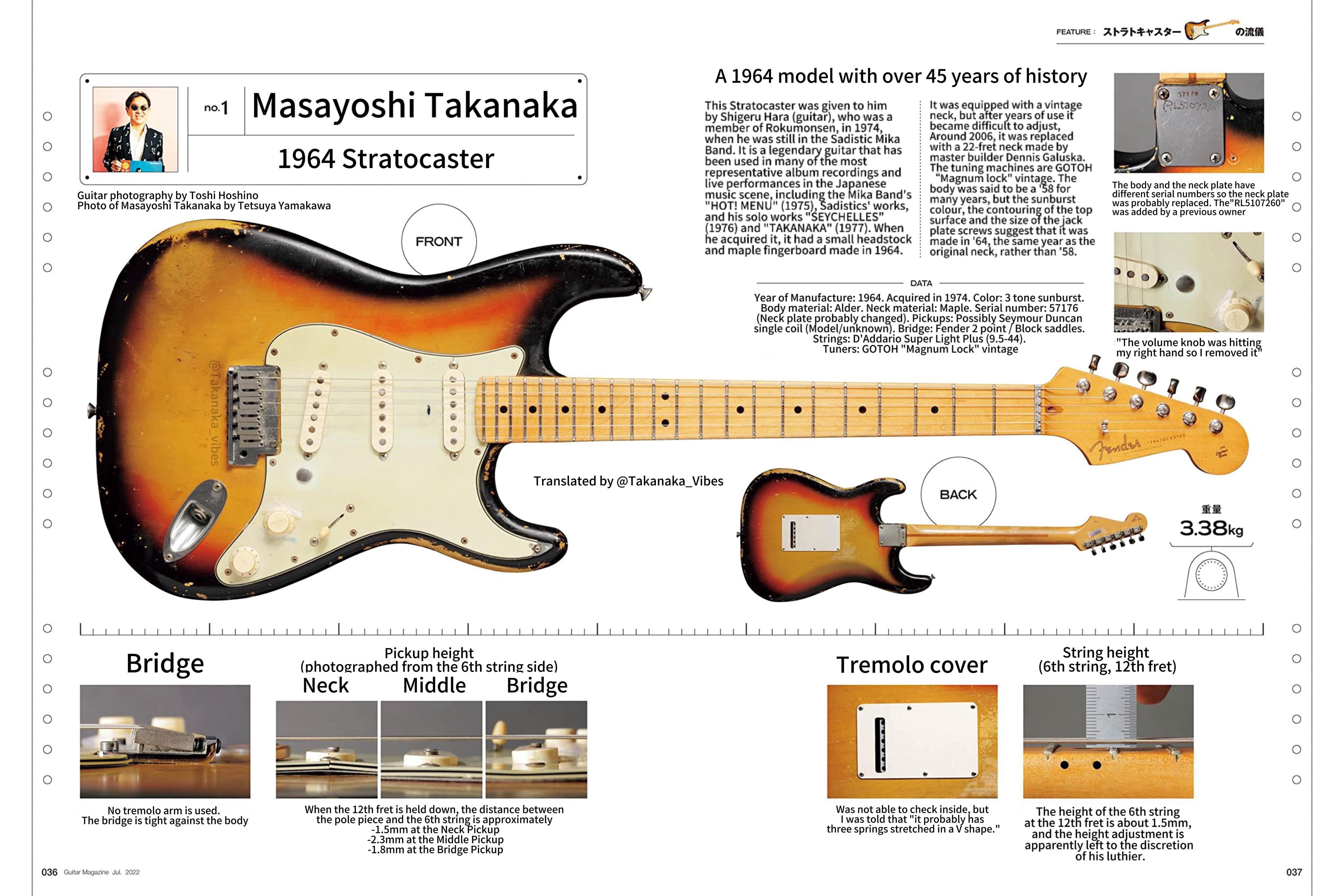
Takanaka's Legendary Stratocaster
Possibly Takanaka's most heavily used guitar, it seems to have never left his side since it was gifted to him back in 1974 by Shigeru Hara. The guitar was used in many Sadistic Mika Band performances including the famous 1975 performance on the BBC program "The Old Grey Whistle Test". In "Takanaka the Book", his 1981 autobiography, Takanaka talks about using this guitar heavily in the studio during his days working as a session musician. It was then heavily featured on many of his early solo albums under Kitty Records. Over 50 years later Takanaka is still rocking his beloved Strat, even using it on his recent 2026 debut world tour.
Modifications
Over the years the guitar has seen many upgrades. The pickups have been changed to what are suspected to be Seymour Duncan single coils (Model unknown). The bridge has been changed from the traditional 6 point bridge to a more modern Fender 2 point bridge. Along with this the bridge saddles were change from the original vintage stamped saddles to modern block saddles. Most notably, the original neck has been changed due to wear and tear. Although the data sheet above says the original neck was replaced in 2006, in the 2004 Takanaka Super Live performance a different neck can be seen. It features 22 frets and a "TAKANAKA" logo along with a palm tree on the headstock. This leads me to believe the current neck is at least the 3rd neck that has been installed on this guitar. The current neck was made by Fender master builder Dennis Galuszka in 2006 (This lines up with the release of the limited edition 2006 Fender Custom Shop Masayoshi Takanaka signature model Stratocaster). It has 22 frets, GOTOH "Magnum Lock" vintage tuners, and a Fender LSR Roller Nut. It is likely Takanaka grew fond of the LSR roller nut when he acquired a Jeff Beck signature model Stratocaster in Olympic White which also has the same nut. He has used this guitar in various live performances over the years and is seen holding it on the album cover for "LITTLE RICHARD meets TAKANAKA".
For a while it was thought that the neck on Takanaka's original Strat was from 1964 and the body was from 1958 but it was later found that the original neck plate had been changed as the serial number on the body was different to the serial number on the neck plate. The body was then identified as being from 1964, the same year as the original neck.
Another notable modification, which has since been present on every Takanaka signature model Stratocaster, is the removal of the volume knob. Instead of the standard 1 volume and 2 tone layout, Takanaka prefers a 1 volume and 1 master tone layout. The volume knob is removed and placed lower in what would normally be the Tone 1 Position. And what would normally be the tone 2 knob now becomes the master tone knob which controls all 3 pickups. He prefers this as the original volume knob position obstructs his picking hand.
Setup
Now lets talk about the setup. Takanaka has stated regularly throughout his career that he uses 9 gauge strings. Although recently he seems to have switched to 9.5 gauge strings (I guess the string breaks finally got to him). Specifically "D'Addario Super Light Plus (9.5-44)". The action at the 12th fret on the low E string was recorded as 1.5mm, which is relatively low. The distance between the pickup pole pieces and the low E string, whilst fretted at the 12th fret, were recorded as follows: Neck 1.5mm, Middle 2.3mm, Bridge 1.8mm. The bridge is setup tight against the body, sometimes referred to as "decked", and Takanaka rarely ever uses the tremolo arm on this guitar.
A fun fact to end this article. You might have noticed the black mark in between the neck and middle pickup. This is a visual reference for Takanaka for the high note in the slide part of "憧れのセーシェル諸島", the 4th song in the album "Seychelles".
Other Specifications
- Body Material: Alder
- Neck Material: Maple
- Finish: Nitro Cellulose
- Weight: 3.38kg
- Pickguard: Most likely original (with aluminium shield underneath, visible on lower horn)
- Serial number: 57176
- Cool Factor: 10/10
As research continues the information on this page may be updated.