
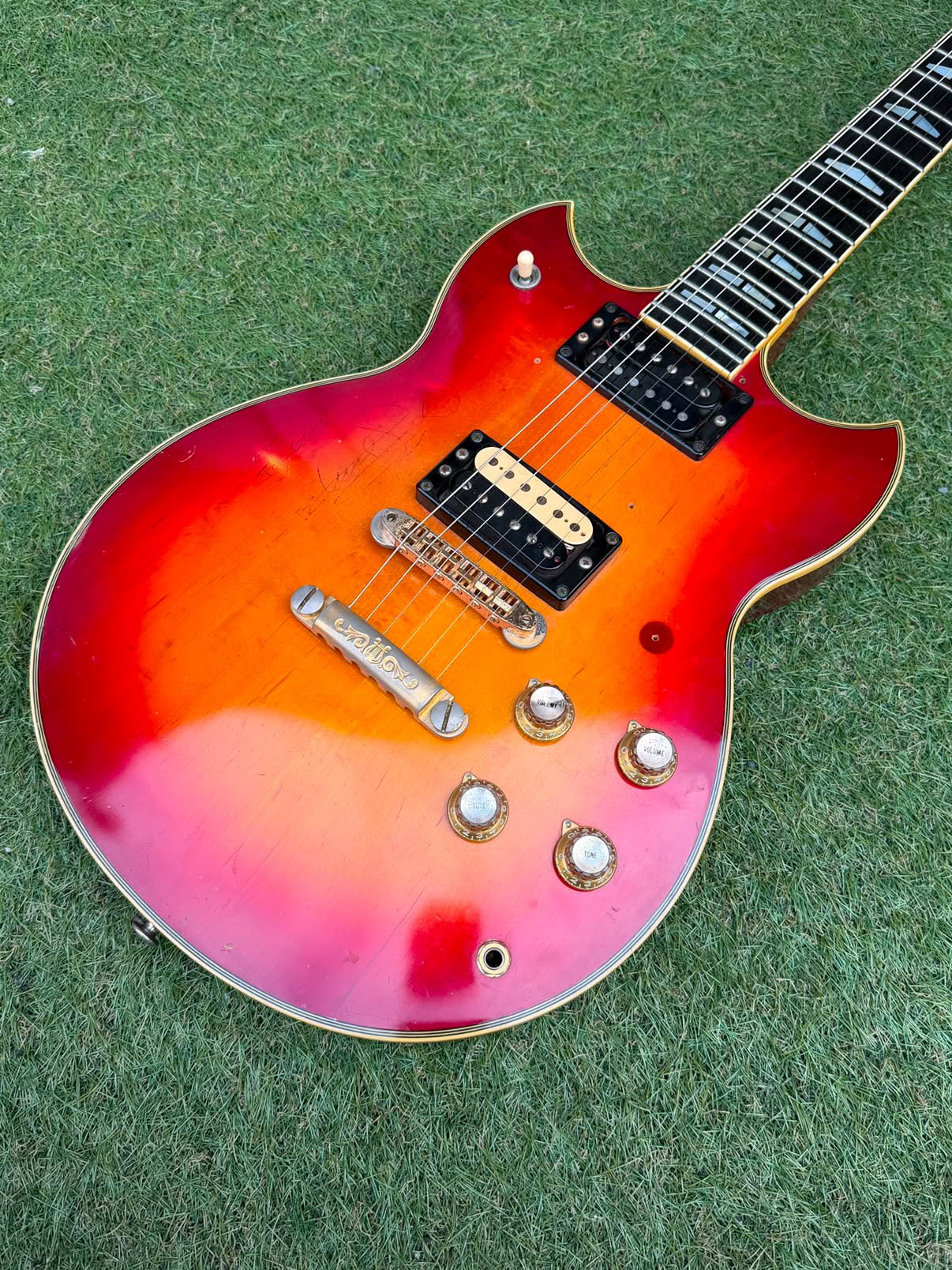
Takanaka's first Yamaha SG
Back in 2023, whilst researching information about the equipment Takanaka had used early in his career, I was introduced to Kenichiro Sakurauchi. A fan of Takanaka since 1982 and the owner of "Kstudio" (I will refer to him as Kstudio for the rest of this article). Through talking to him i discovered that he was in possession (On loan) of Takanaka's original 1976 Yamaha SG1000! This is the guitar Takanaka used to record "Blue Lagoon" and "The Rainbow Goblins" studio album as well as many others. It can be seen being used live in many of Takanaka's early performances as a solo artist in the mid to late 1970's and was even used in the famous 1981 collaborative tour with Carlos Santana. It's last known appearance in the hands of Takanaka was during the Takanaka Super Live 2010 tour when he borrowed the guitar back from the person he gifted it to. Yes, you read that right, he gave the guitar away.
Amongst fans in Japan this guitar has earned the nickname the "Crab Legend". Takanaka Lived in the Bahamas from 1990-2003. In 1995 a Japanese business man called Mr Goro visited the Bahamas on holiday. By chance, he met Takanaka and they had a few drinks together. During this conversion Takanaka mentioned that he liked crabs. When Mr Goro returned to Japan he decided to send Takanaka some crabs as a gift. In return, Takanaka gifted him his Yamaha SG1000 along with a handwritten note. The note read "This guitar is old and doesn't look very good, but I used it to record Blue Lagoon and other songs about 15 years ago... Please feel free to play it whenever you have some free time". But unfortunately, Mr Goro is left handed.
Mr Goro has kept the guitar in the same condition as when he received it. In 2007 he reached out to Kstudio, an established Luthier who specialises in Yamaha SG's, after seeing an article published by Kstudio about the pink SG Takanaka used for the studio album "SAUDADE" (visible in the cover art for the album). Kstudio had purchased the famous pink SG in 2004 after spotting it in a deteriorating condition in a shop window, more on that in a future article. Mr Goro contacted Kstudio asking if he could perform some maintenance on the guitar.
Upon receiving the guitar in June 2007, Kstudio carried out a detailed inspection of the guitar which he kindly documented. Below i will leave you with Kstudio's in depth article of this iconic guitar, translated to english, along with the original photos he took at the time. Below Kstudio's article I will add some additional notes as well as extra photos of the guitar showing it's present condition as of July 2026. These photos were kindly provided by Kstudio.
Takanaka's SG1000 in detail (By Kstudio)
First of all, I should say that it’s borrowed, so...
In June 2007, an SG that seemed almost unbelievable arrived at K STUDIO for maintenance.
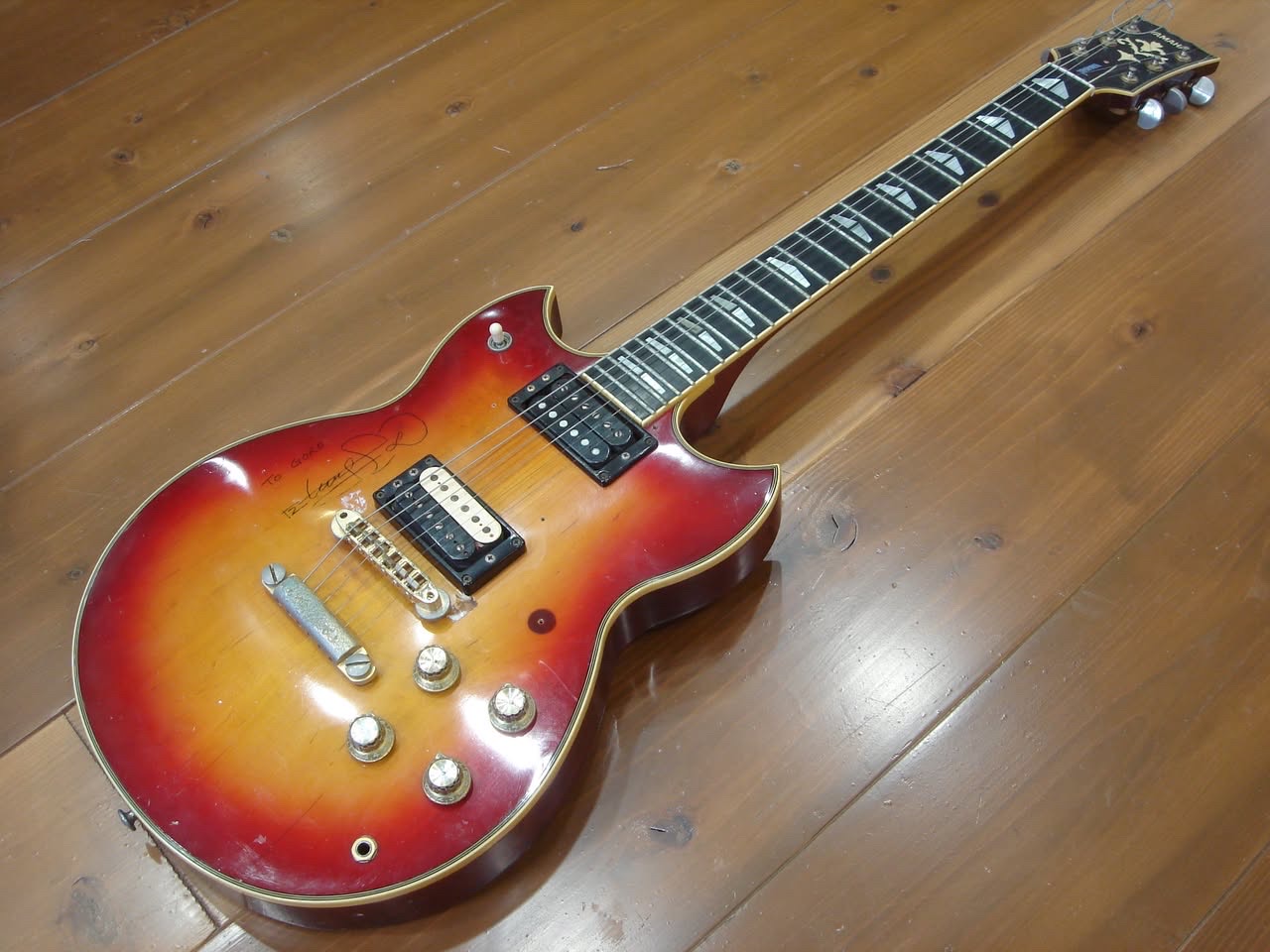
It was the first SG Mr. Takanaka ever owned, and is said to have been used on the recording of the famous song “BLUE LAGOON,” so it is truly an incredible piece.
I’m sure it had an impact on Mr. Takanaka’s own life as well, but when I think about how many fans’ lives it must have influenced, there is something very profound about it... I am definitely one of those people who was influenced by it. (laughs)
This SG is currently owned by a man named GORO, who received it as a gift from Takanaka around 1995 (amazing!). I had heard the story of how he acquired it, long before I started this website, through word of mouth as the "crab legend". When I asked GORO about the legend again, he said, "I met Takana in the Bahamas at the time, and since he said he liked crabs, I sent him some crabs after returning to Japan, and then he gave me the SG."
And apparently, there was a handwritten note included with the guitar that read, "This guitar is old and doesn't look very good, but I used it to record Blue Lagoon and other songs about 15 years ago...". It also said, "Please feel free to play it whenever you have some free time," but GORO kept it in the same condition as when he received it until 2007. Then, one day, he saw the pink SG section on this website and contacted me asking if I could do some maintenance on it, which I was very interested in, so I agreed.
At first glance, it looks like a very ordinary SG1000, and if you ignore the historical context and just look at the guitar, it's a very ordinary, beat-up SG with no custom color or special features (lol).
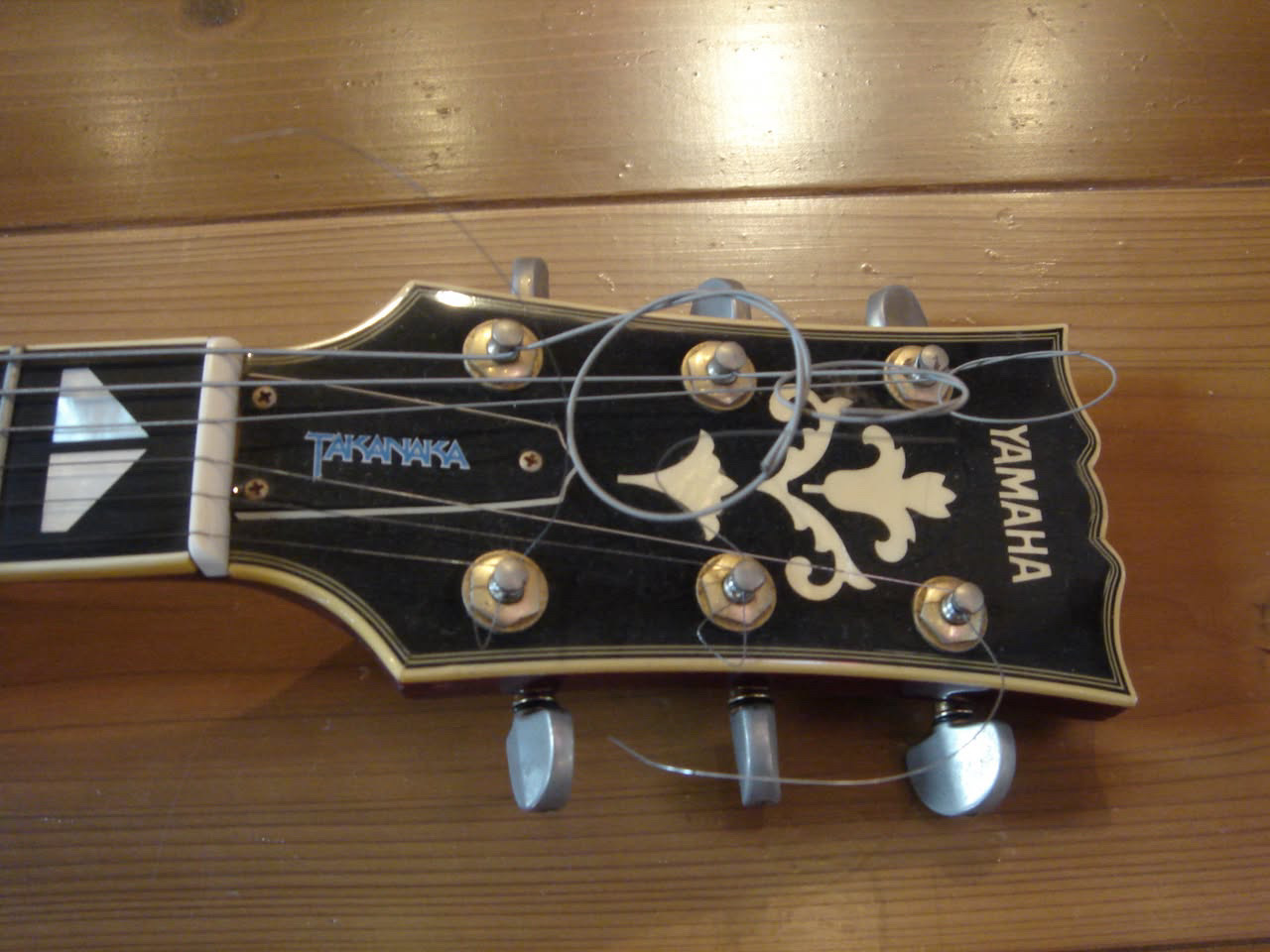
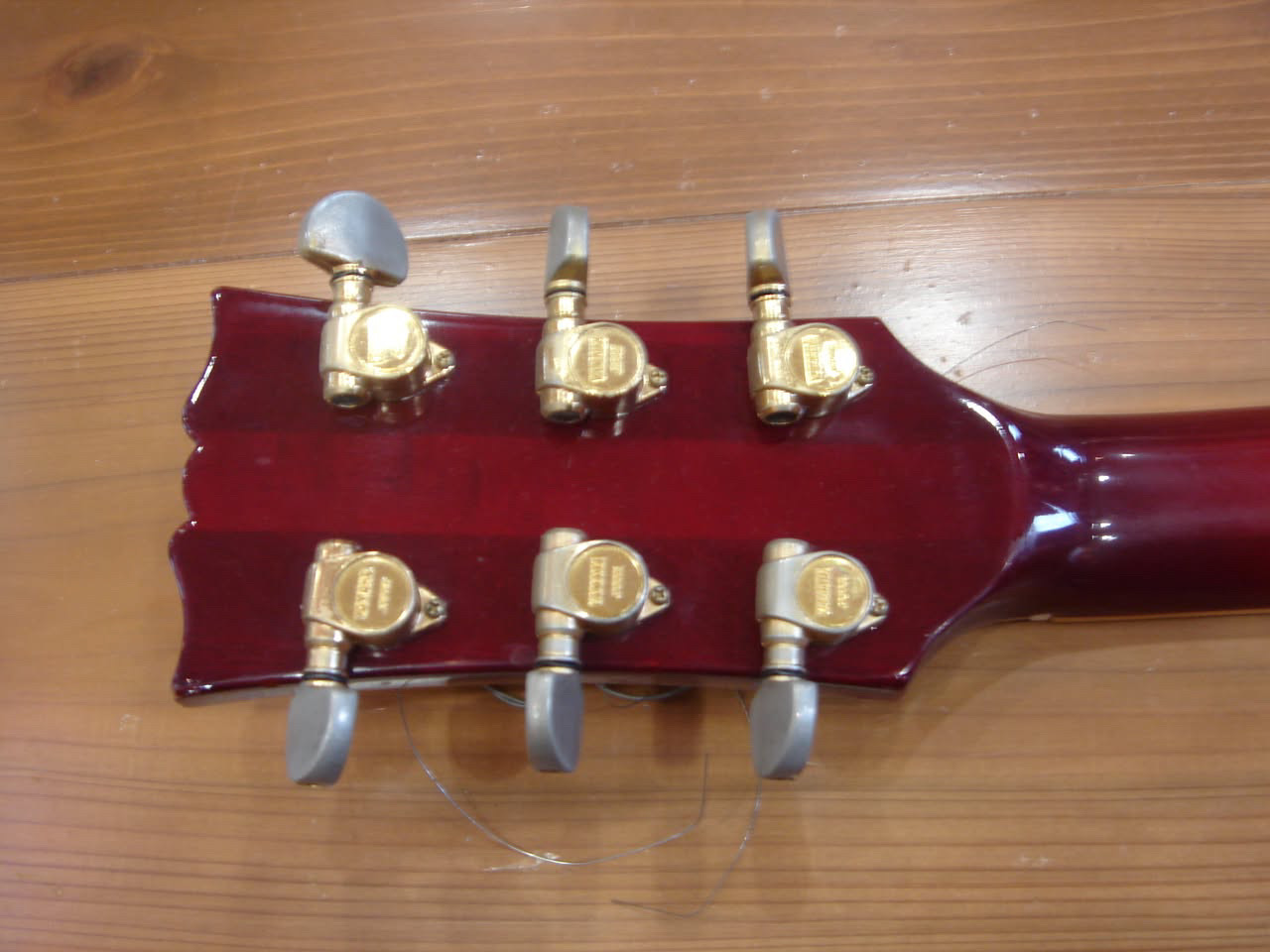
However, since it's an early SG1000, it has the distinctive large headstock shape, which is its most distinctive feature.
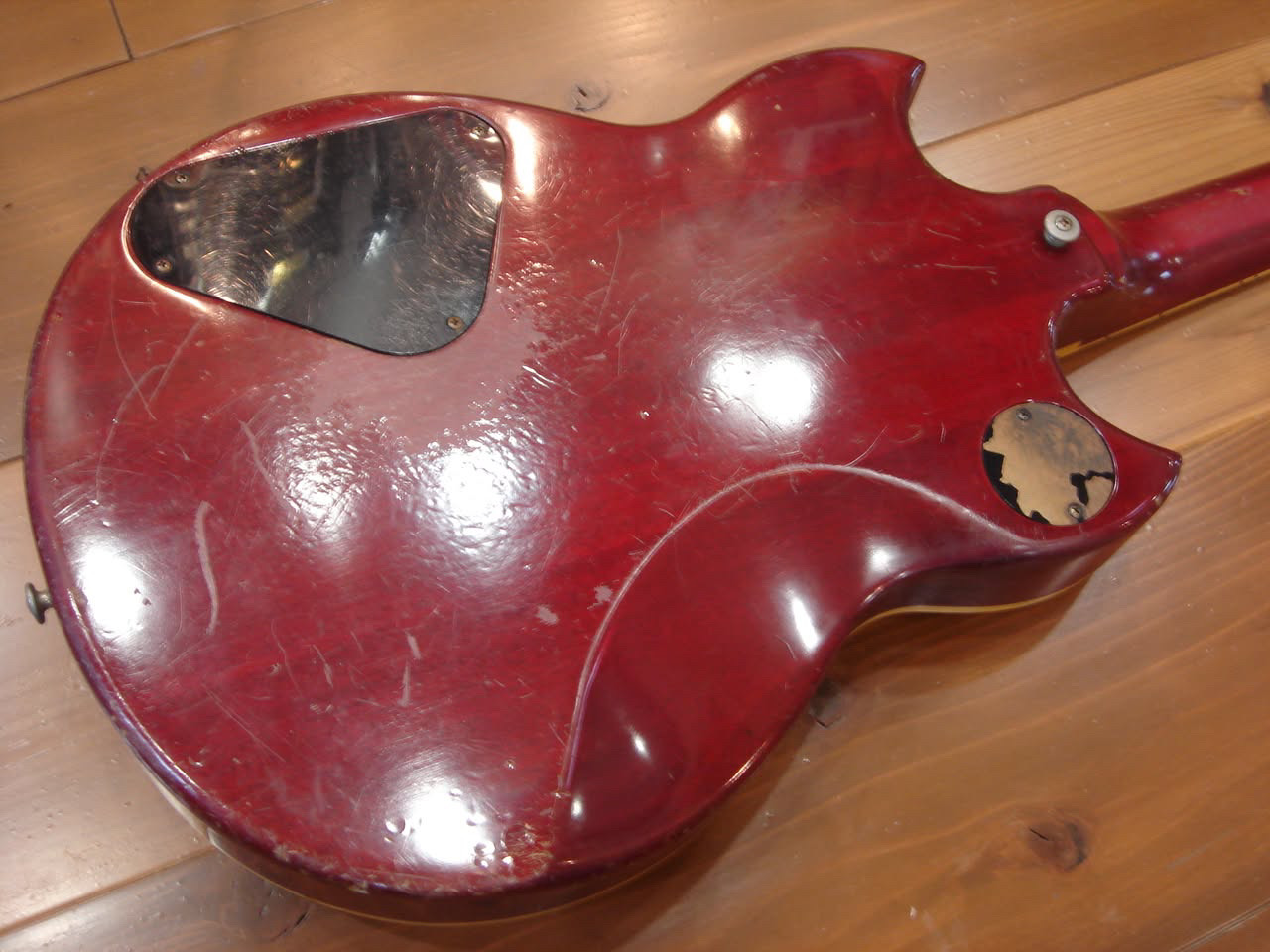
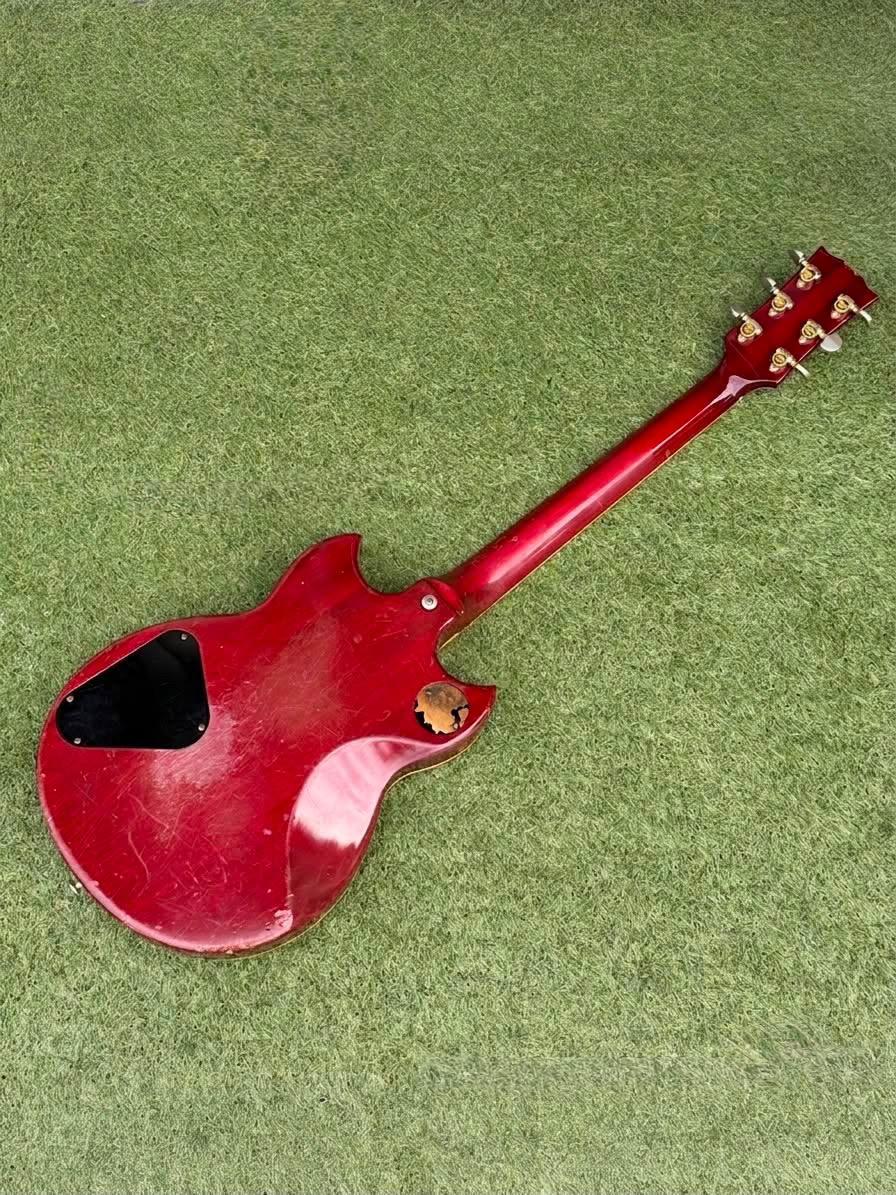
The back of the body has countless buckle scratches and other marks. The protective paper on the toggle switch is still attached. If you don’t peel that off at the beginning, it becomes quite difficult to remove.
I also weighed it. It was 4,440 g, which I think is a standard weight for an SG, though I remember the large-head SGs I have seen in the past being heavier.
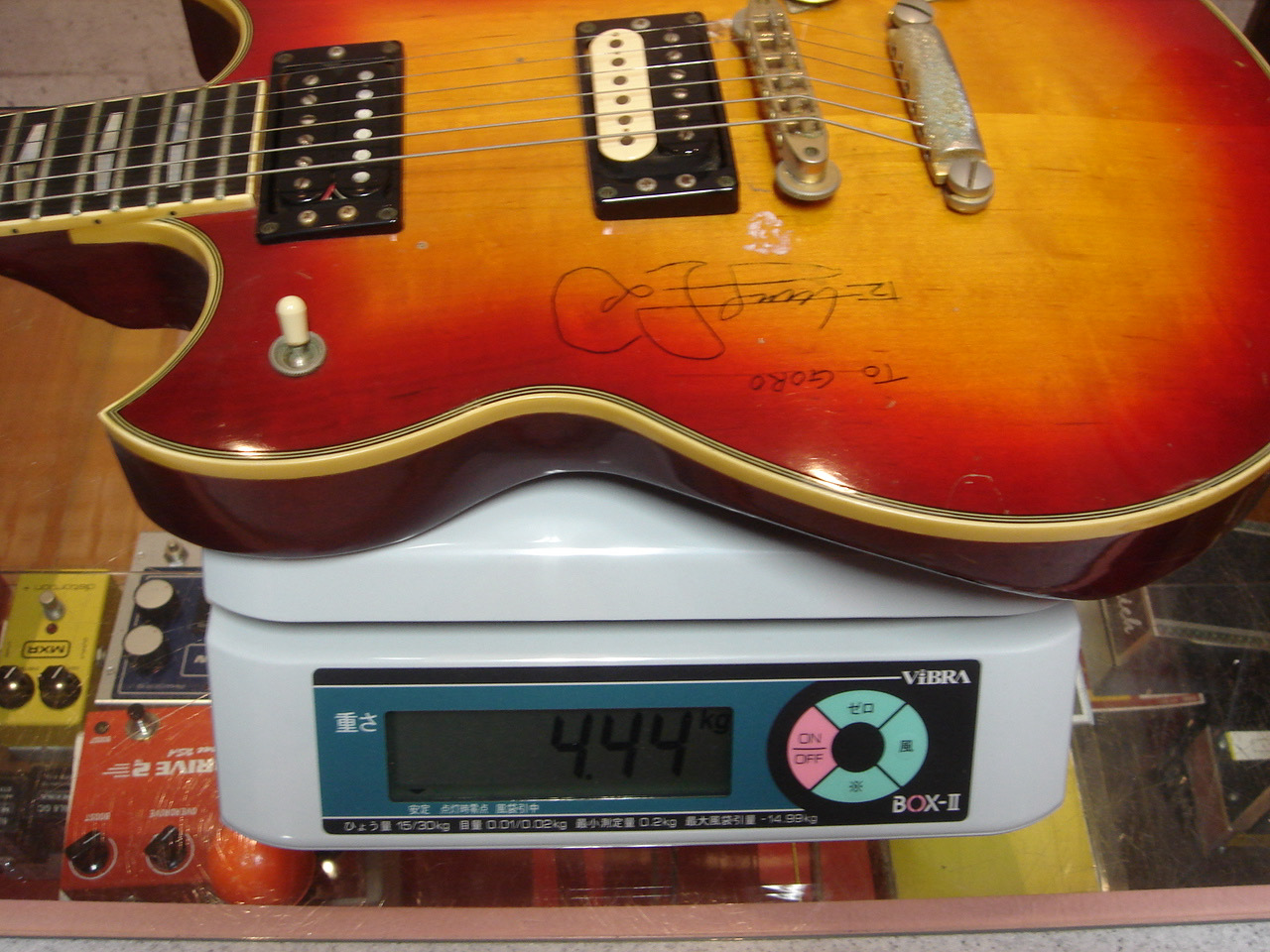
The finish is lacquer, and the serial number is #1328. Since the pickups have been replaced, the year of manufacture cannot be determined by looking at the pickup date, but in SG GRAFFITI, published by Shinko Music, there is a guitar with an extremely close serial number, #1314, also with a lacquer finish, and its pickup date is October 1976. I also asked Mr. Shigeru Terada, well known as an SG researcher, to appraise it, and he said that the nut also appears to be original and that it has features seen on 1976 models, so I think there is no problem in regarding it as a 1976 model.
The current owner said that he had not changed the strings even once since receiving it from Mr. Takanaka, so I measured them before removing them. My digital calipers have an inch mode, so when I switch to inches and measure them, the numbers correspond to the markings written on string packages.
The measurement results are from .0085 to .0430. For comparison, I measured a D’Addario .009 string I had on hand, and it was also around .0085, so this is a .009 set.
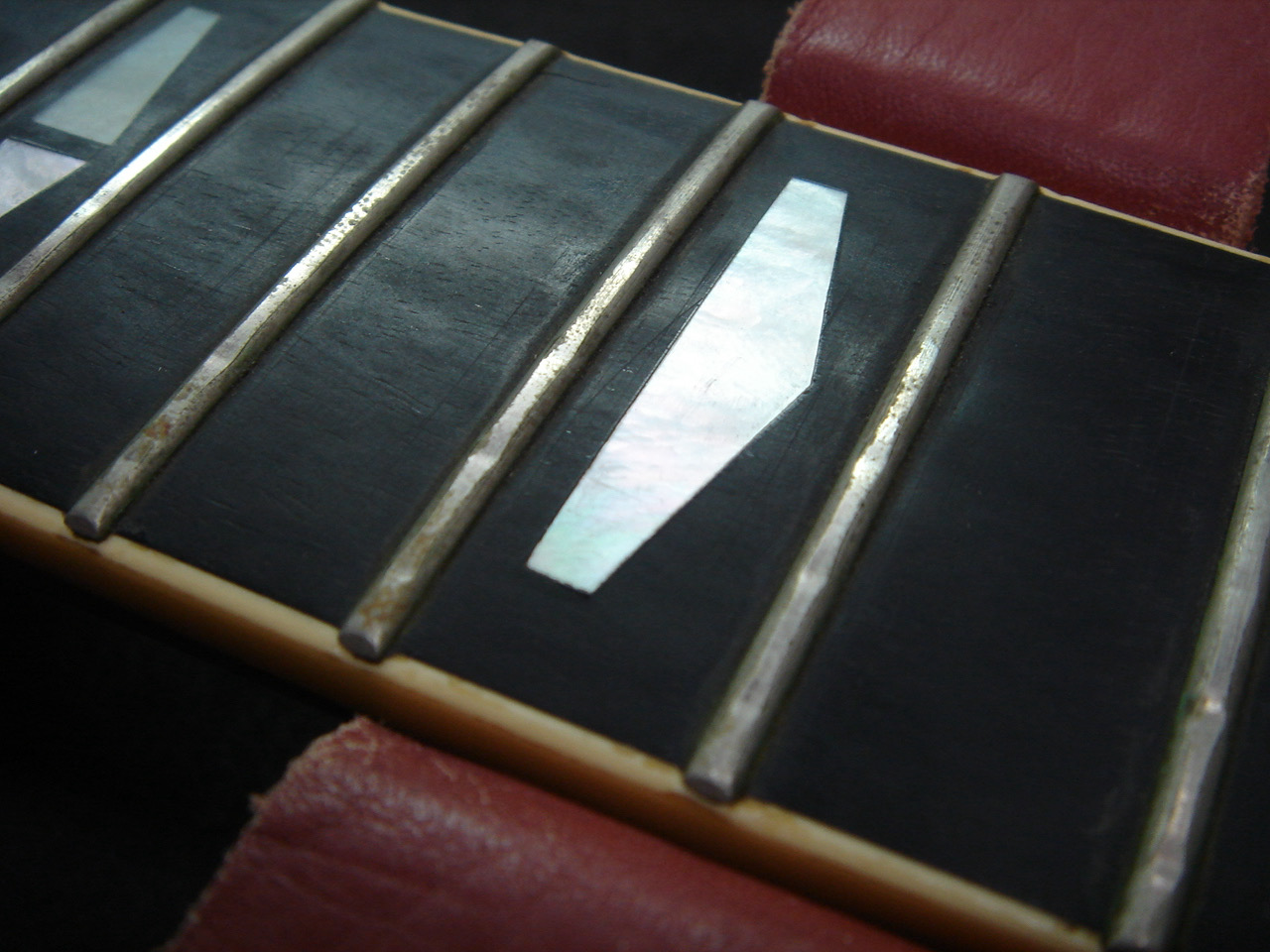
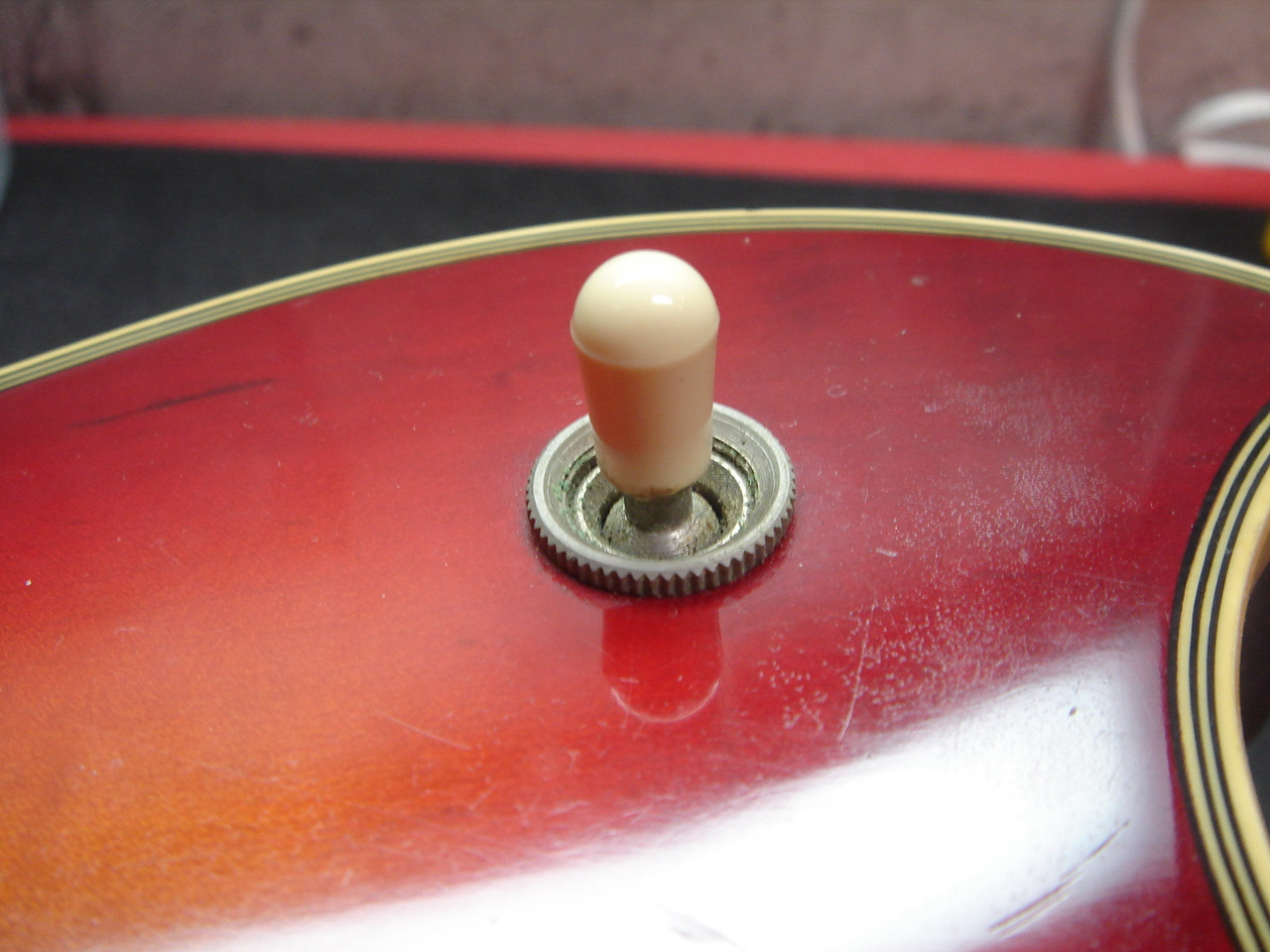
The frets are quite worn. It's been played a lot. The toggle switch has been replaced with a Switchcraft one, but since it's a consumable part, I think it's been replaced many times before.
And the photo above shows the rubber residue left when the pickguard was removed.The rubber hasn't melted and stuck on; as you can see, the wood grain is showing through and it's smooth. This must be due to the interaction between the rubber and the lacquer.
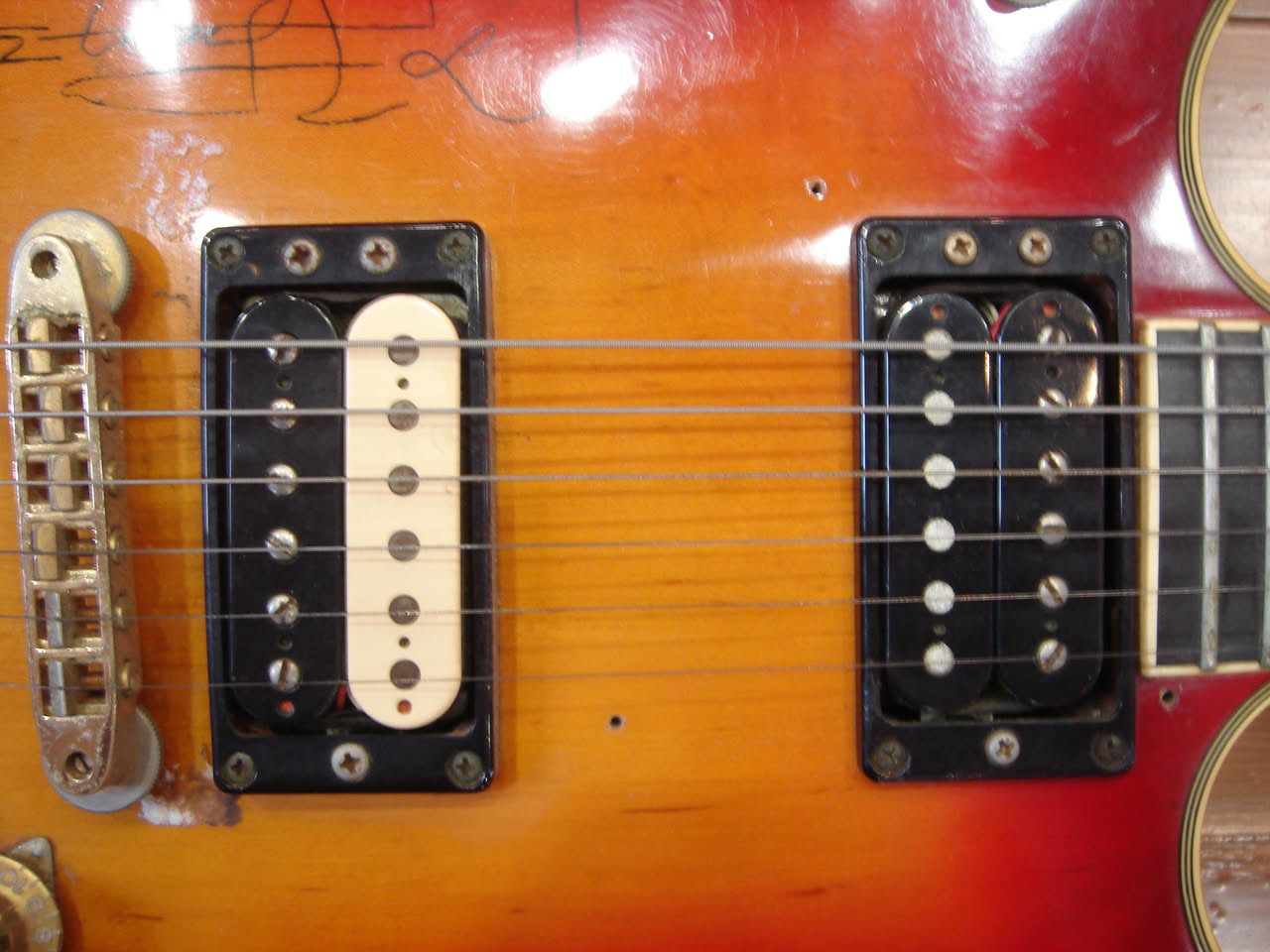
The bridge is currently the narrow type found on early SG3000s.
And the pickups... you're probably wondering what they are, right?! I'll tell you later.
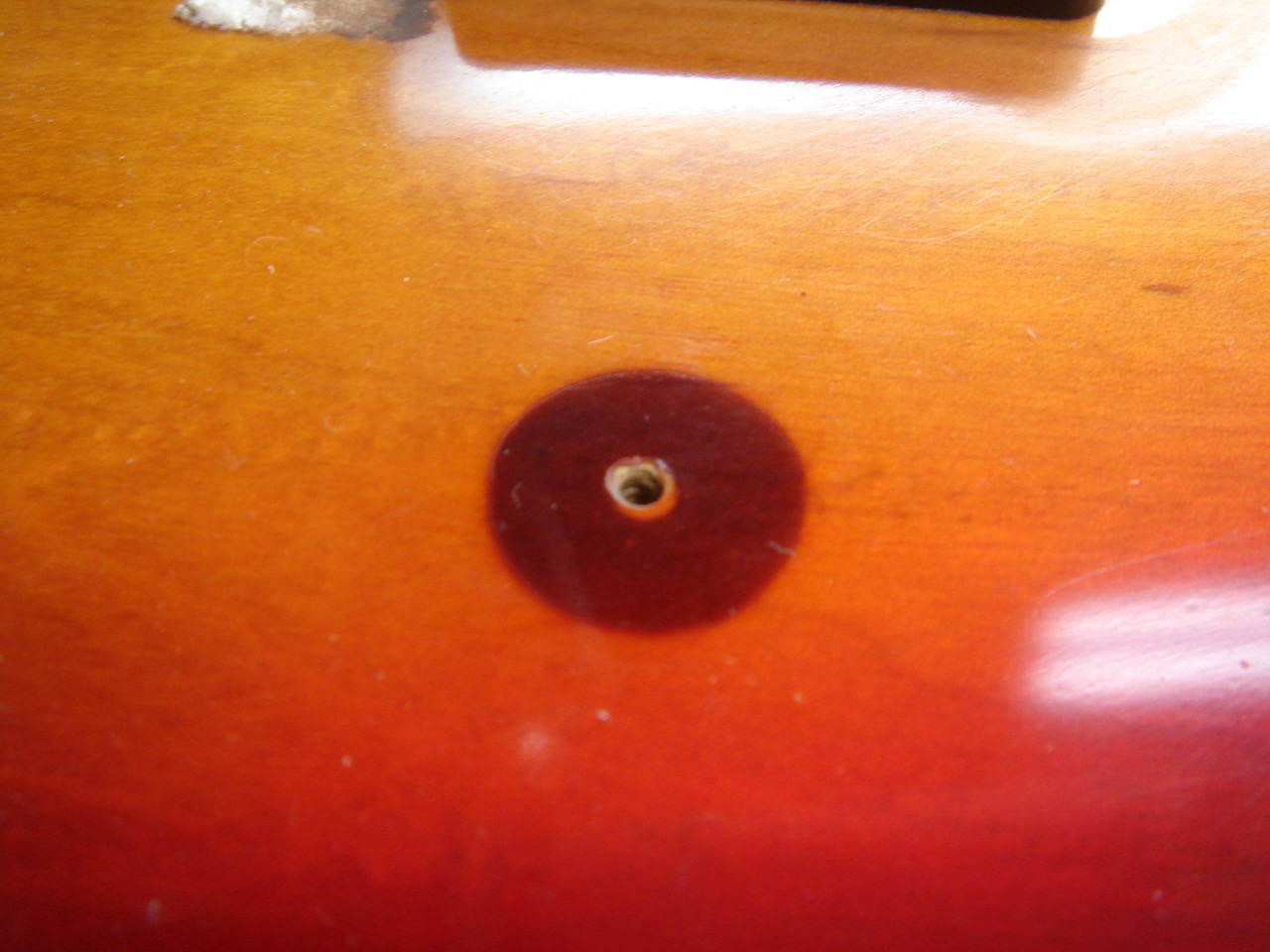
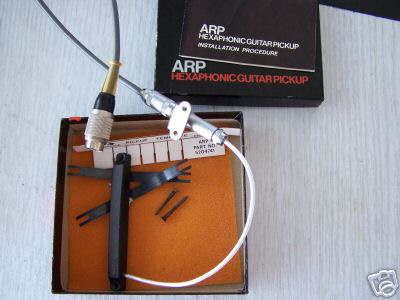
Also, the two holes drilled between the pickups are from when a guitar synth pickup was installed. Normally, this pickup would be mounted near the bridge, but there wasn't enough space on the SG, so it was mounted in the center.
This guitar synth is made by ARP (how did I know that?) and the unit itself is a keyboardless synth that only produces single notes. The keyboard version of this is called the Odyssey, which YMO also used.
Now, regarding the pickups, there were various theories, but the correct answer is numbered PAFs. The pickup dates are 1980.07.23 for the neck and 07.24 for the bridge.
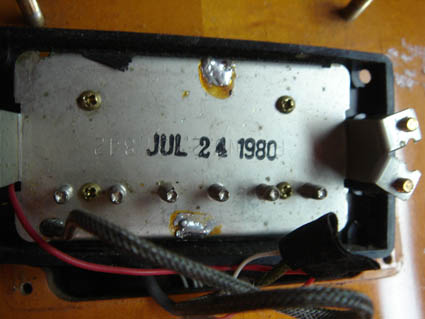
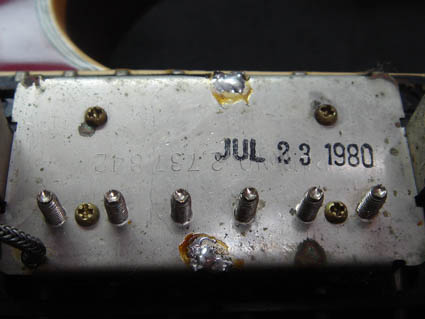
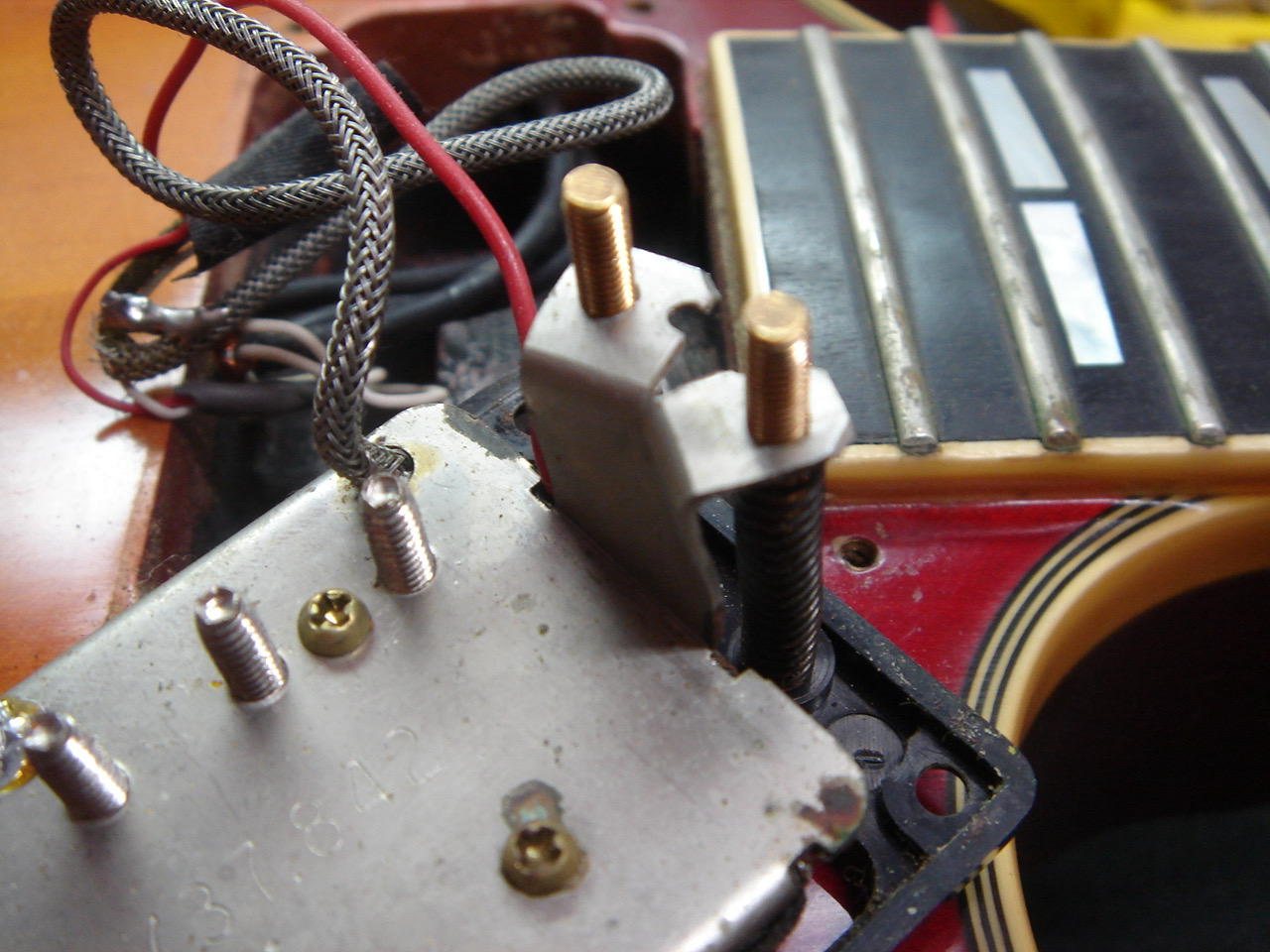
However, they modified the two-point mounting to a three-point mounting in an extremely simple and rational way. I never would have thought of this myself (laughs).
However, this method is not applicable to all aftermarket pickups, as the length of the pickup legs or the depth of the cavity may vary depending on the manufacturer or the year of the SG, so those who attempt a similar modification should measure carefully.
The red wire in the photo is for the tap, and the Bi-Sound wiring had also been done properly.
Since the recording of “BLUE LAGOON” was before these pickups were made, that sound was probably recorded with the SG’s normal pickups.
An extremely precious item! Without this, it really would just be an ordinary SG.
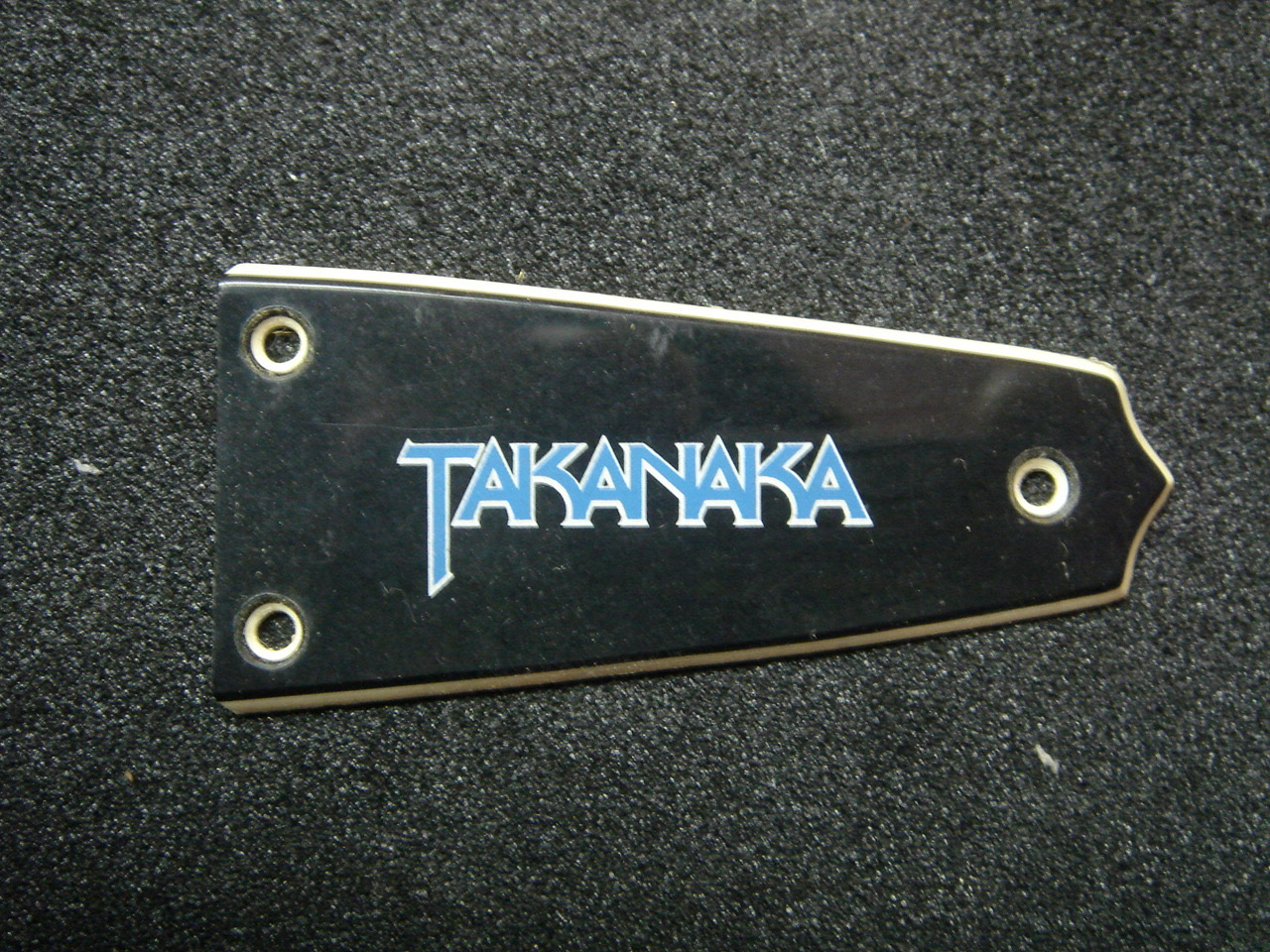
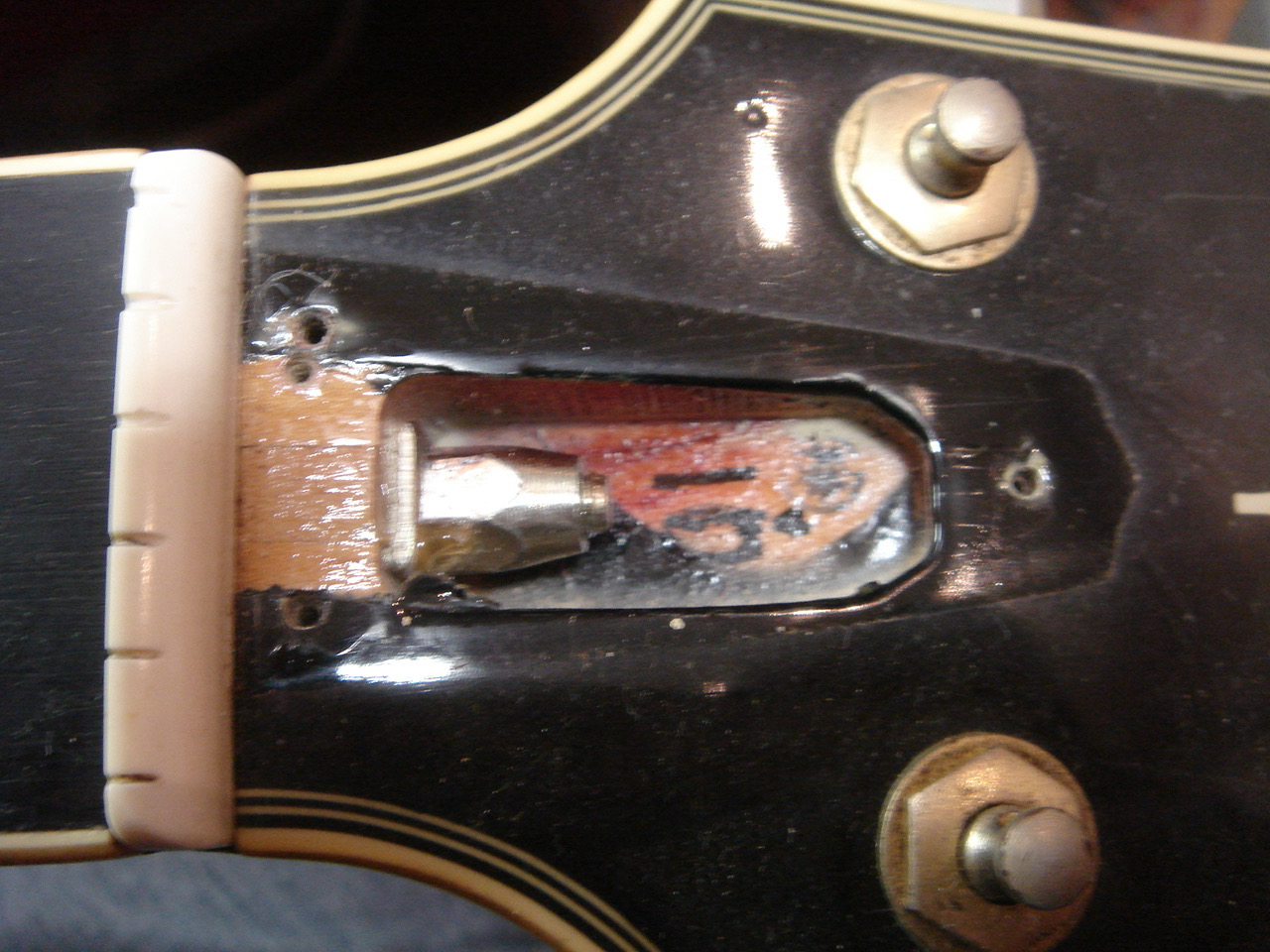
The truss rod cover appears to have originally been mounted slightly off-center towards the 6th string, but the screw holes on the TAKANAKA logo rod cover are wider than the original hole pitch, and the screw holes on the 1st string side were left as they were while new holes were drilled only on the 6th string side, so it's quite a bit off-center.
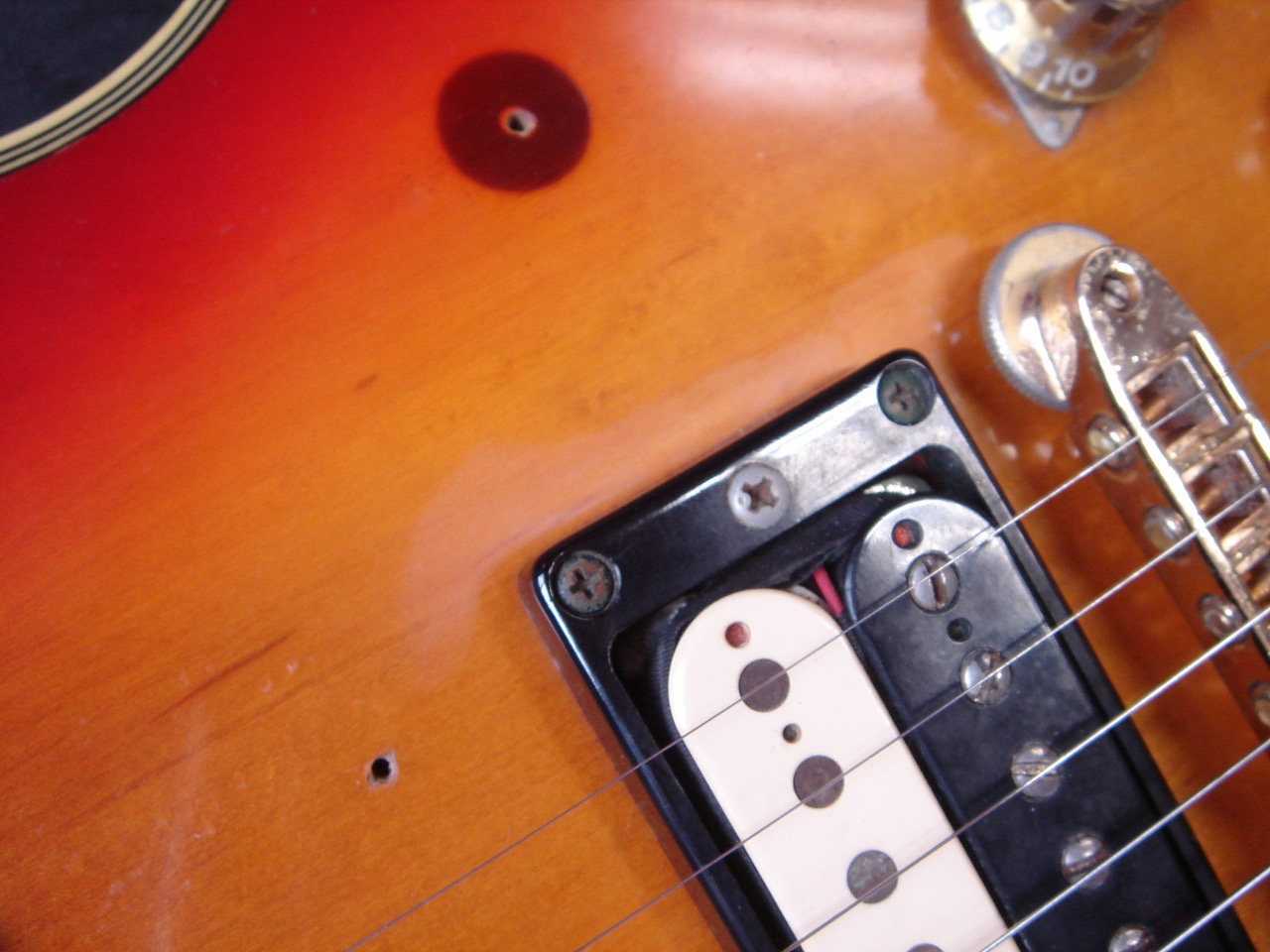
The photo below shows a white, stained area next to the bridge pickup ring. This appears to be scratches caused by Takanaka's distinctive playing style, where he wraps his hand around the pickup ring while playing. The lacquer leaves the marks quite noticeable.
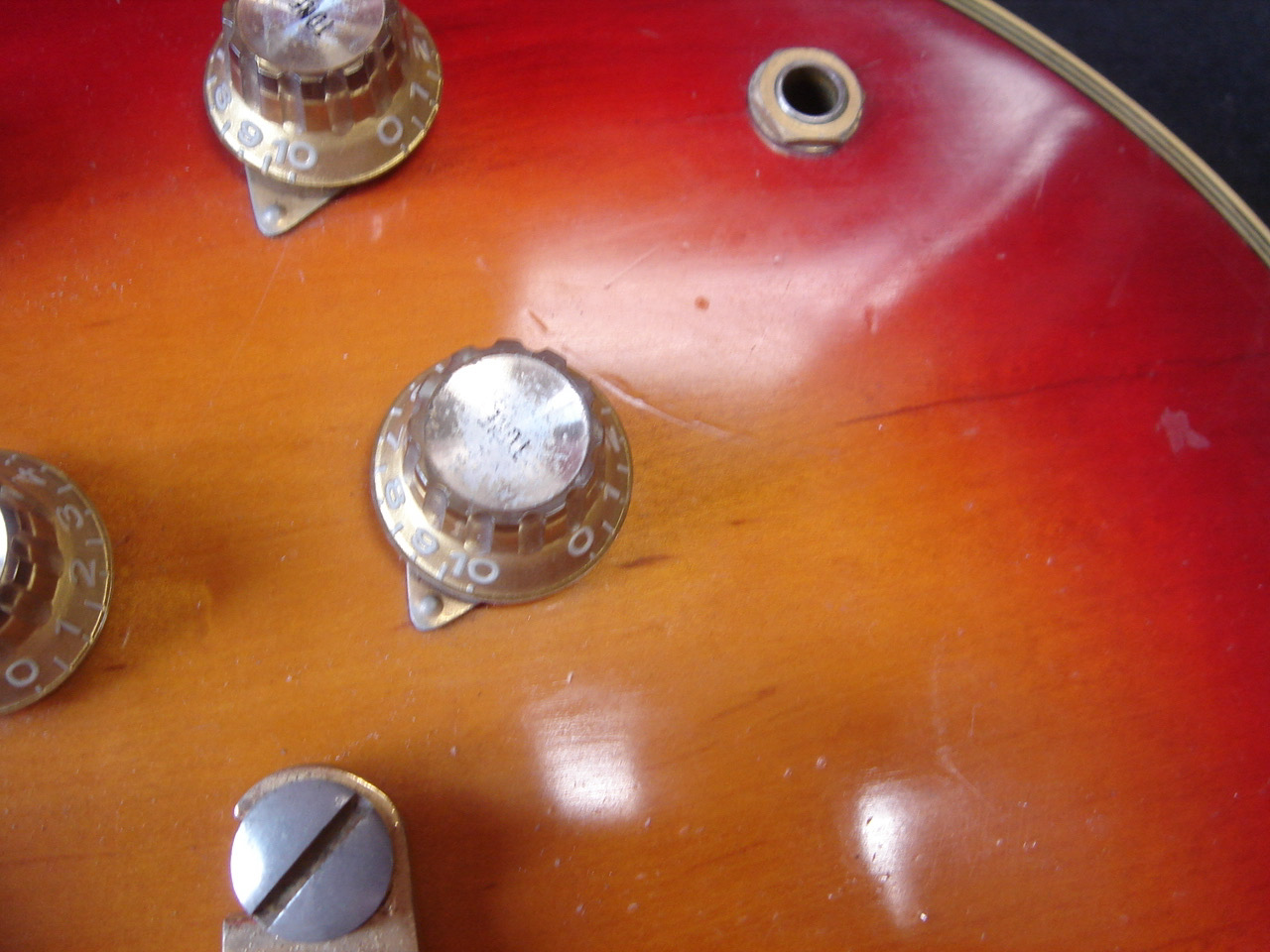
These are scratches made by the Orange Squeezer. Can you see how they form an arc centered around the jack? When I see things like this, all kinds of scenes come to mind, and I can’t help but feel moved that it really is the real thing.
While checking various things, the most shocking discovery was that there had been a neck break repair. Some time ago, I had heard a rumor that Mr. Takanaka’s SG1000 had no serial number, so maybe it was a prototype, but that was the reason.
However, because it is a neck with maple sandwiched inside, it does not seem to have been completely broken, but rather repaired by gluing a crack. There is no repair history on the headstock side, and no reinforcing material has been inserted.
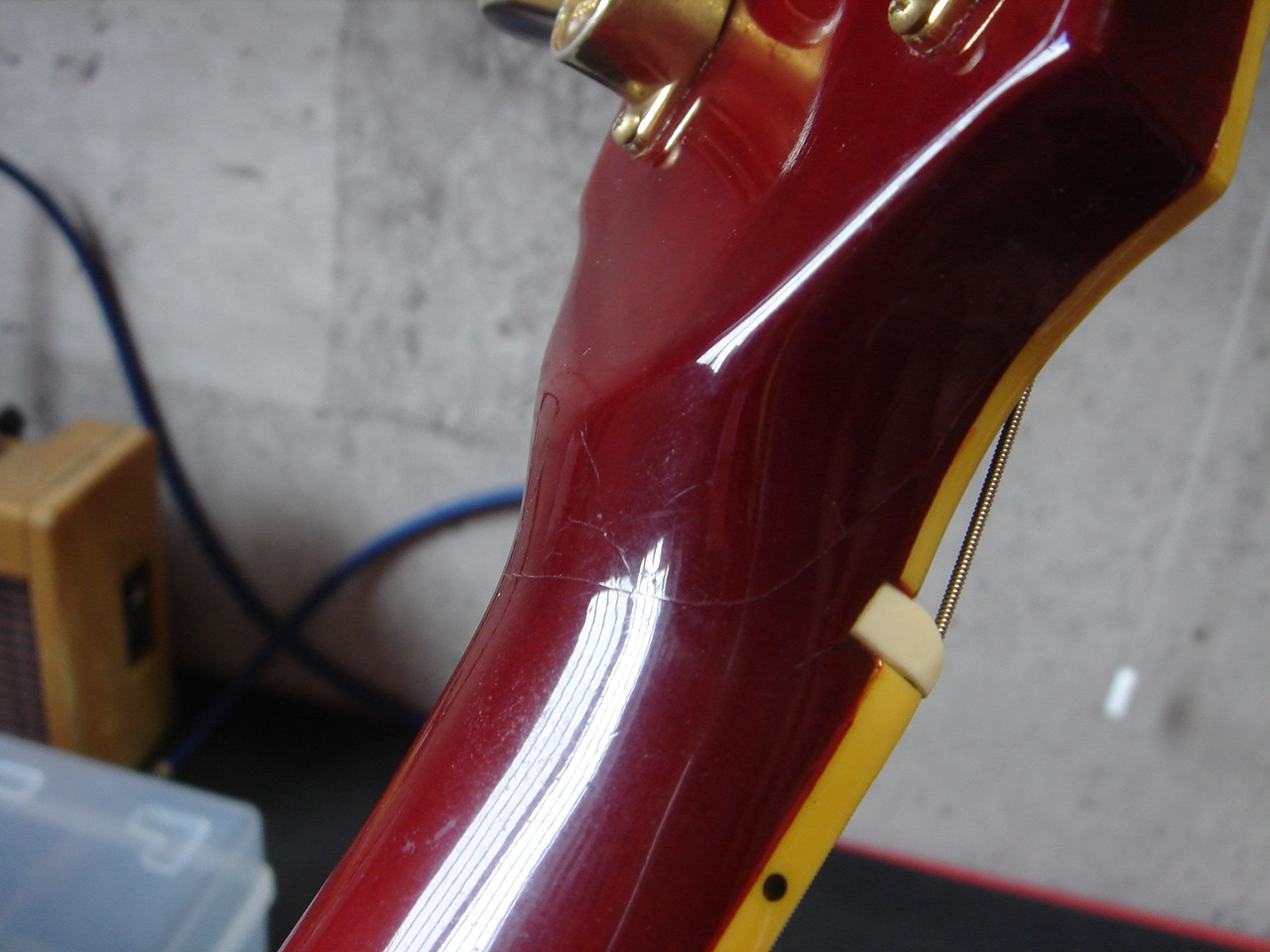
The refinishing from the repair extended only as far as the middle of the neck.
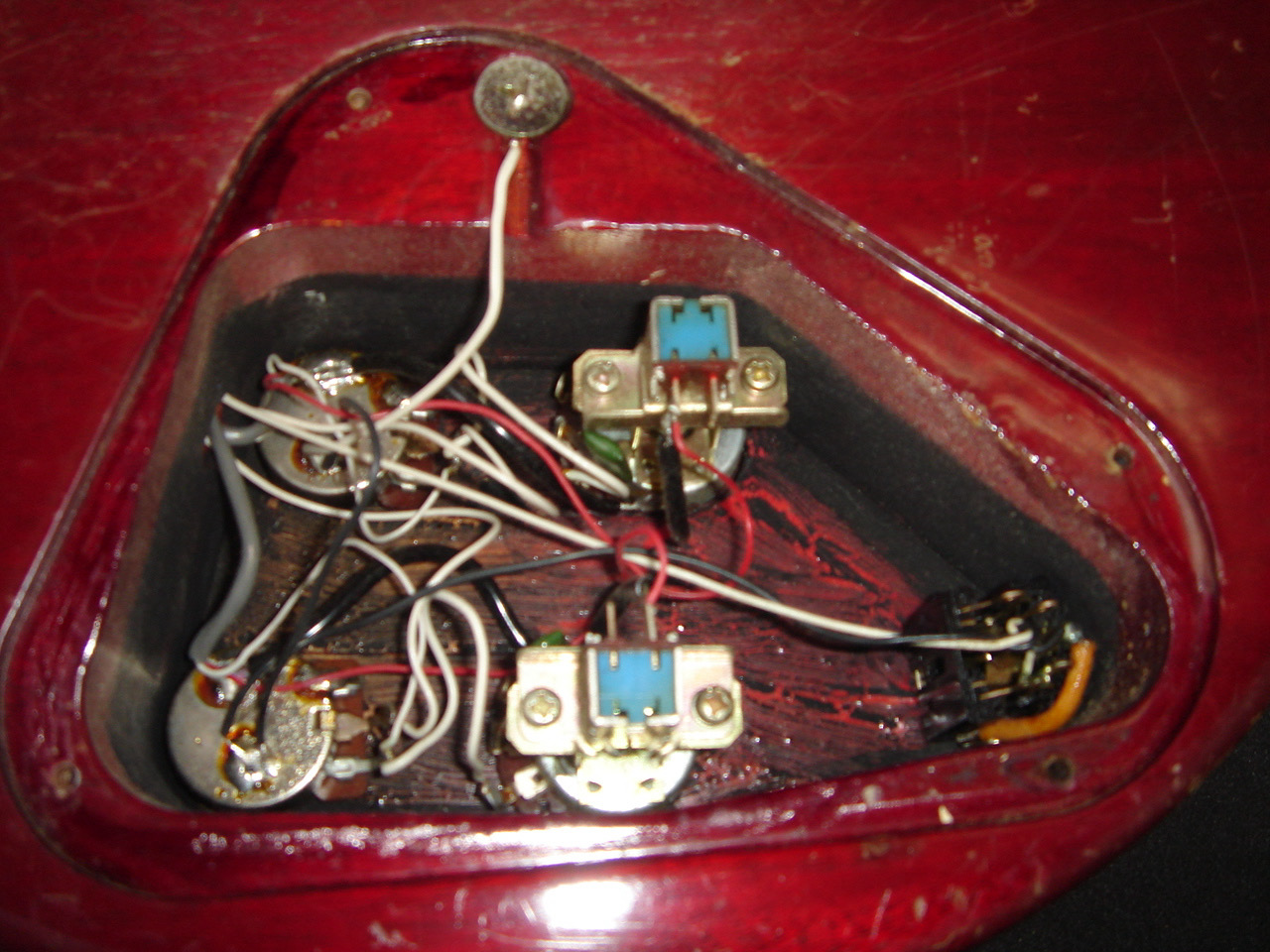
The pots and wiring have all been replaced. Since it is a professional tool, that is only natural. The conductive paint has been applied rather roughly. In particular, there is no shielding treatment at all, such as aluminum sheet on the cover side.
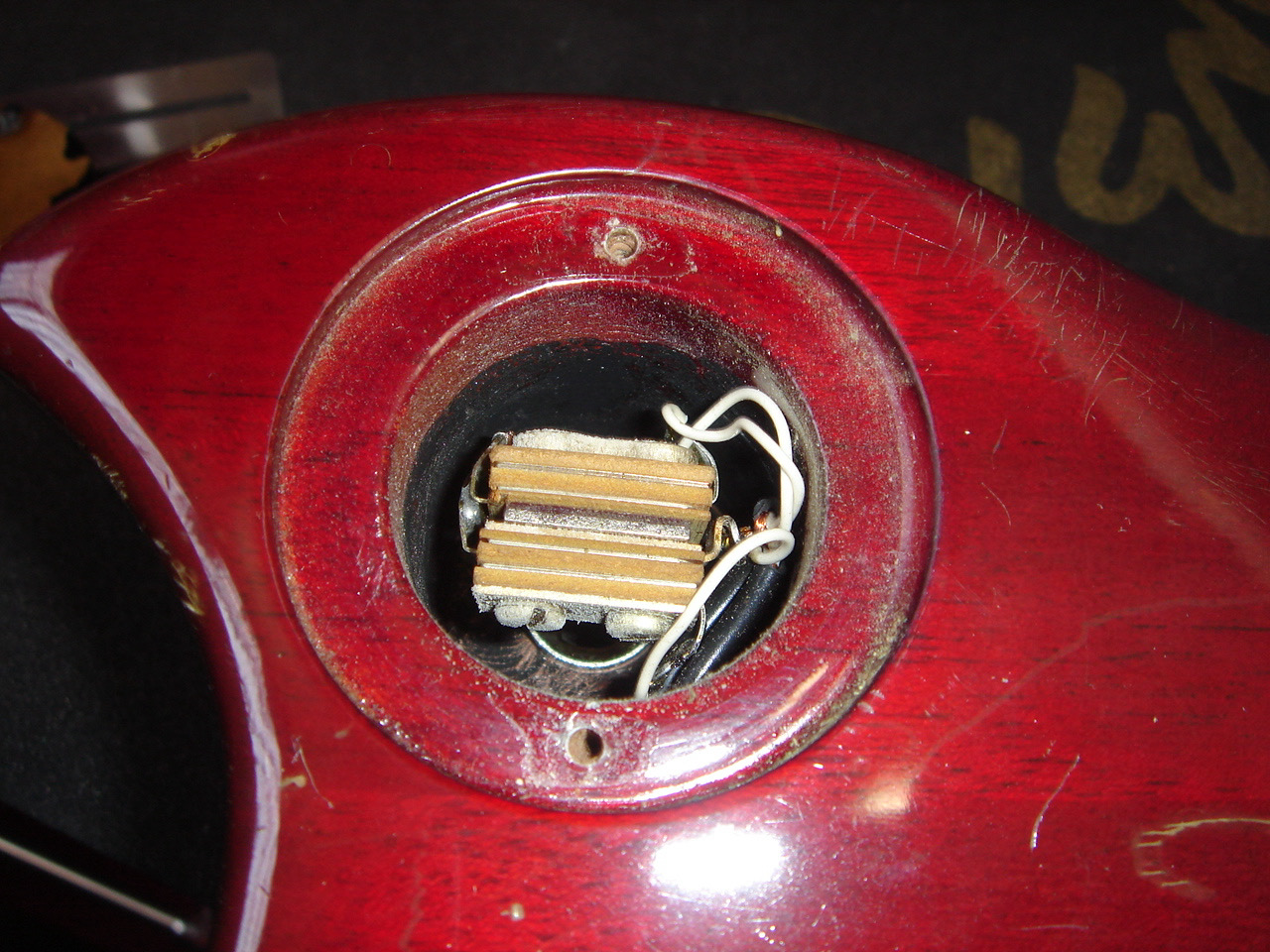
The nut on the front side is rusted, so I did not forcibly disassemble it, but there were no problems such as poor contact.
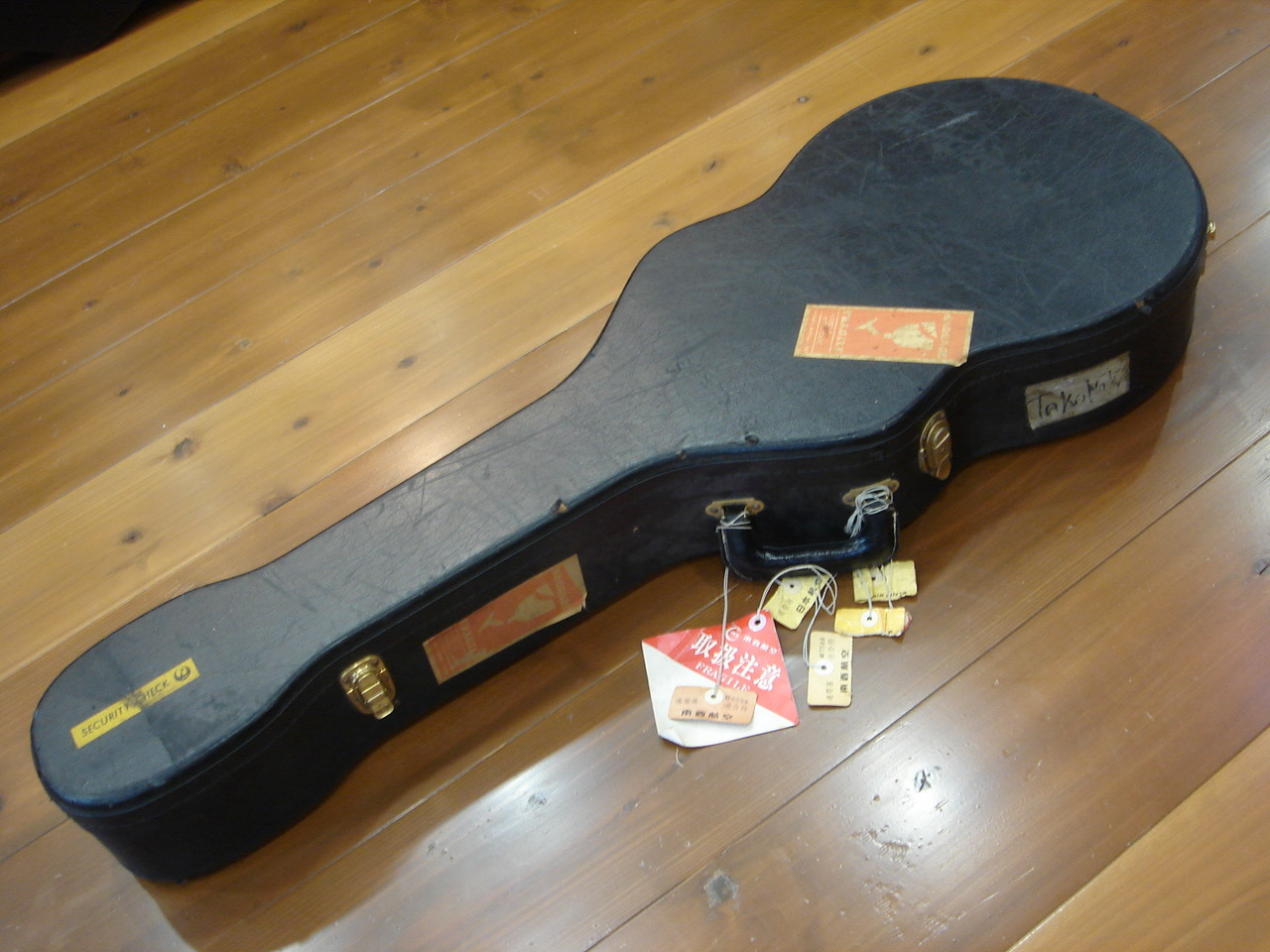
The hard case is original. Most of the many tags hanging from it are from Southwest Airlines, now Japan Transocean Air, an airline that flew to the Okinawa area. Come to think of it, around the time of Natsu Zen Kai, he was recording in Okinawa with this guitar too.
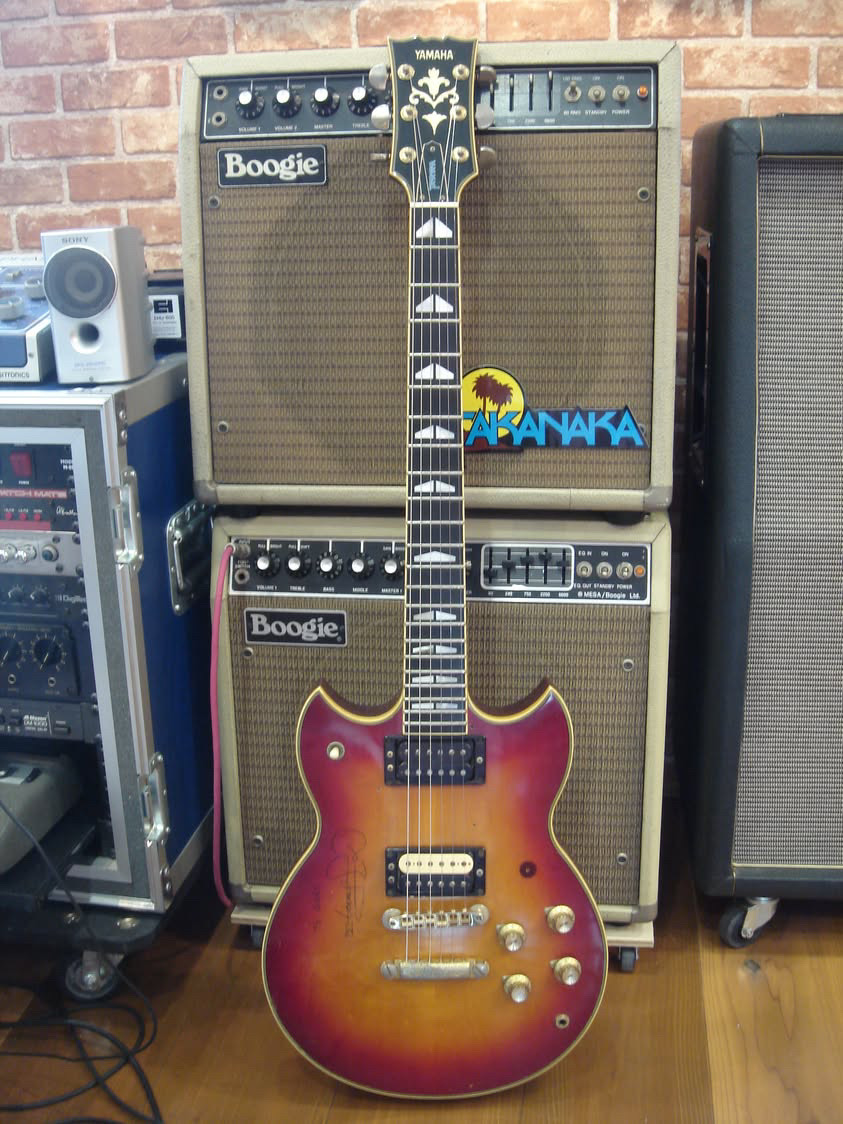
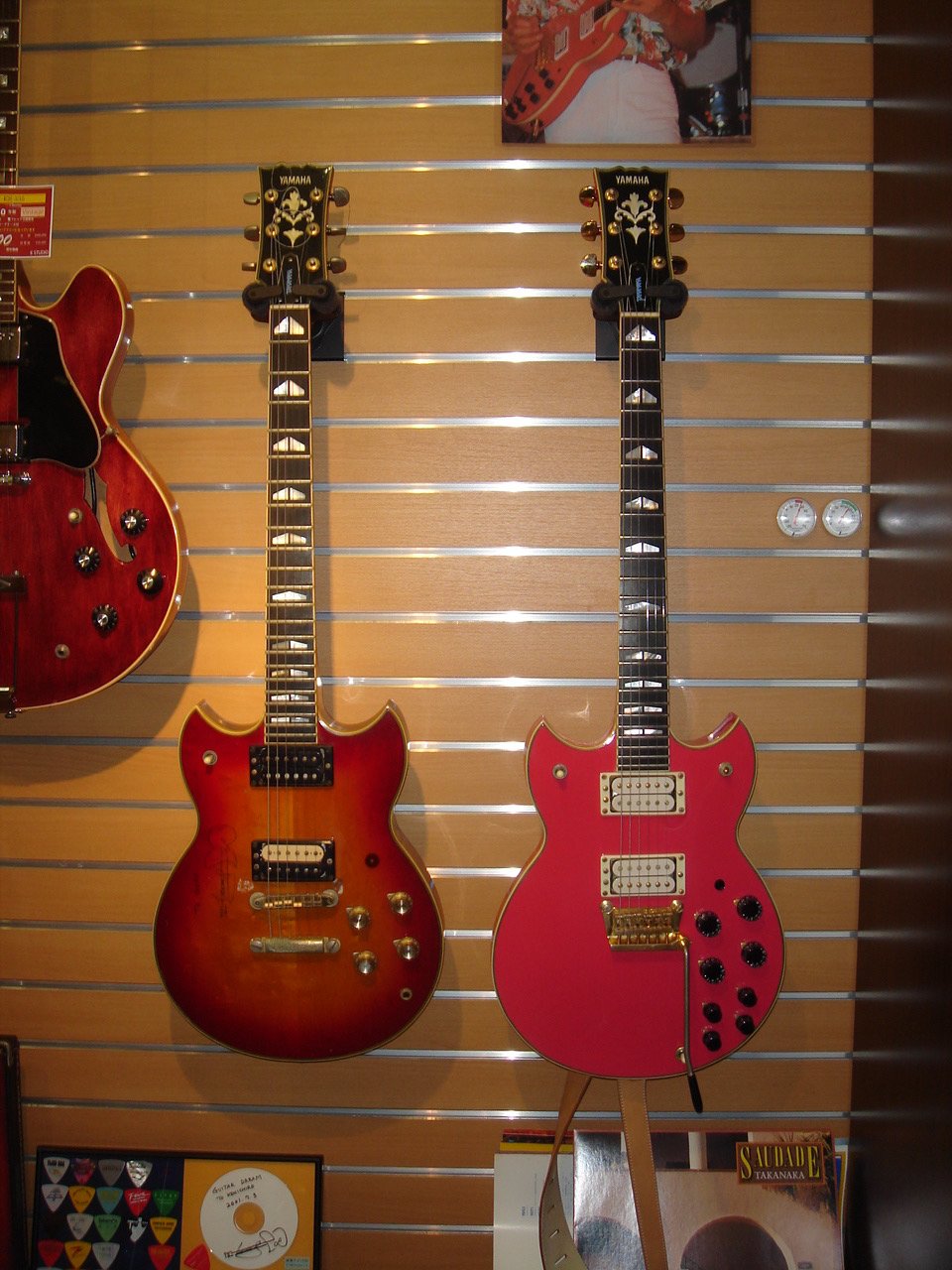
I would like to say thank you to Kstudio on behalf of the Takanaka community for his dedication towards researching and archiving information about Masayoshi Takanaka. The information he has gathered over the years is priceless. I recommend you go follow him on Instagram for his regular updates and occasional sales of high quality guitars he has worked on. He is a true craftsman.
Additional notes
In Takanaka's 1981 autobiography "TAKANAKA The Book" he says he first started using this guitar around the time of his 2nd studio album "TAKANAKA" in 1977. At this time the guitar was mostly stock. It had Yamaha's stock OPG-1 humbucker pickups. As Takanaka did not acquire his next Yamaha SG (the custom blue SG2000) until 1979, this guitar saw a lot of use in his following studio albums and live performances. According to Takanaka this guitar was used to record his iconic hit song "Blue Lagoon" from his 1979 album "JOLLY JIVE". This would have been recorded with the stock OPG-1 pickups.
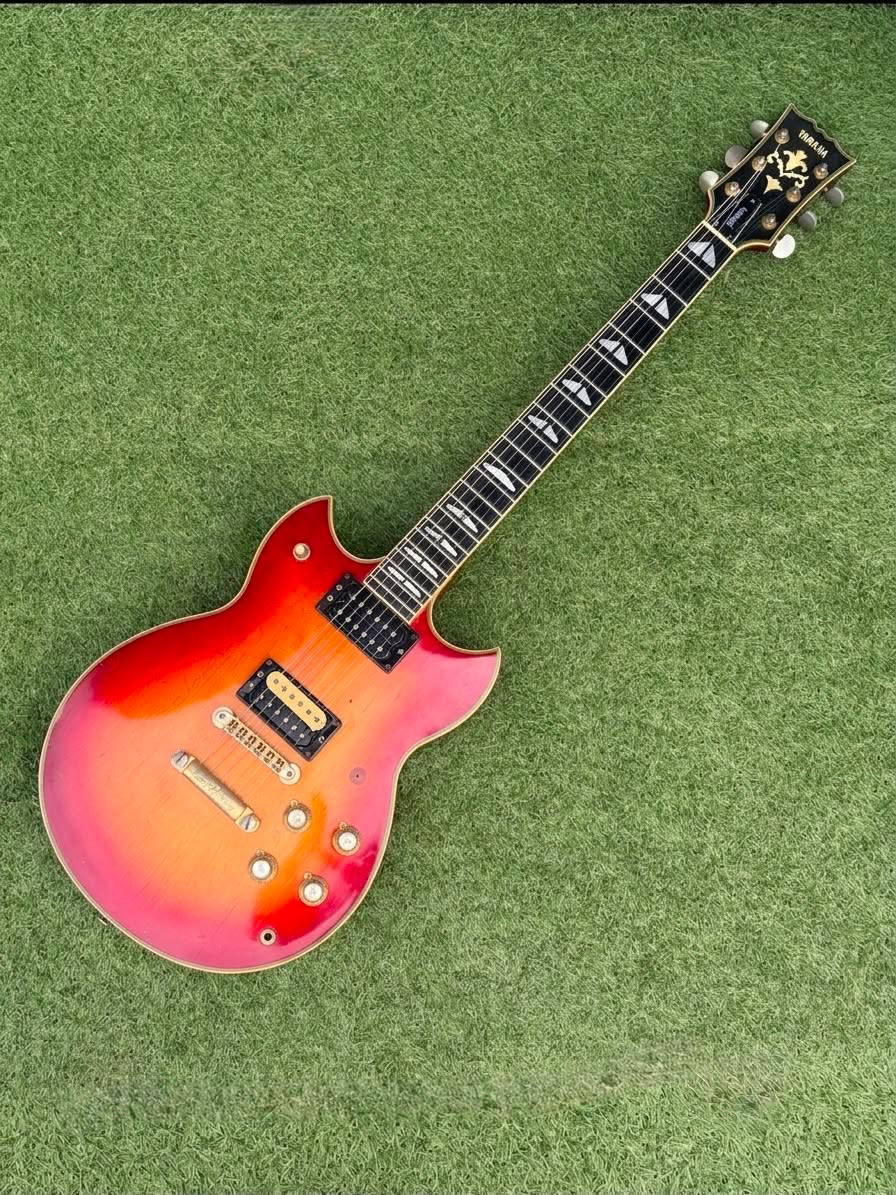
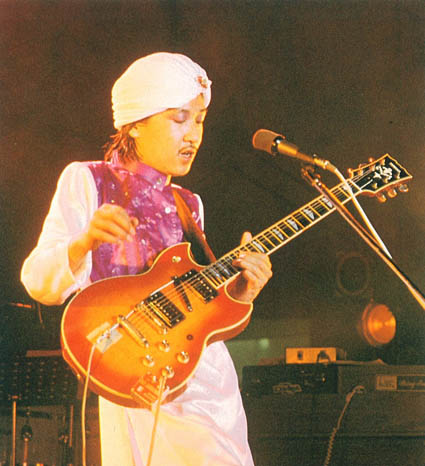
The pickups were then changed later in 1980 to Gibson PAF humbuckers. Below are two images from "THE RAINBOW GOBLINS" (1981) recording sessions. If you look closely at the bridge pickup you can see the pickup has a white bobbin that indicates the PAF's were installed by this time. As the album was released on March 10th 1981, and the pickups are dated July 1980, I think it's safe to assume these were installed in late 1980.
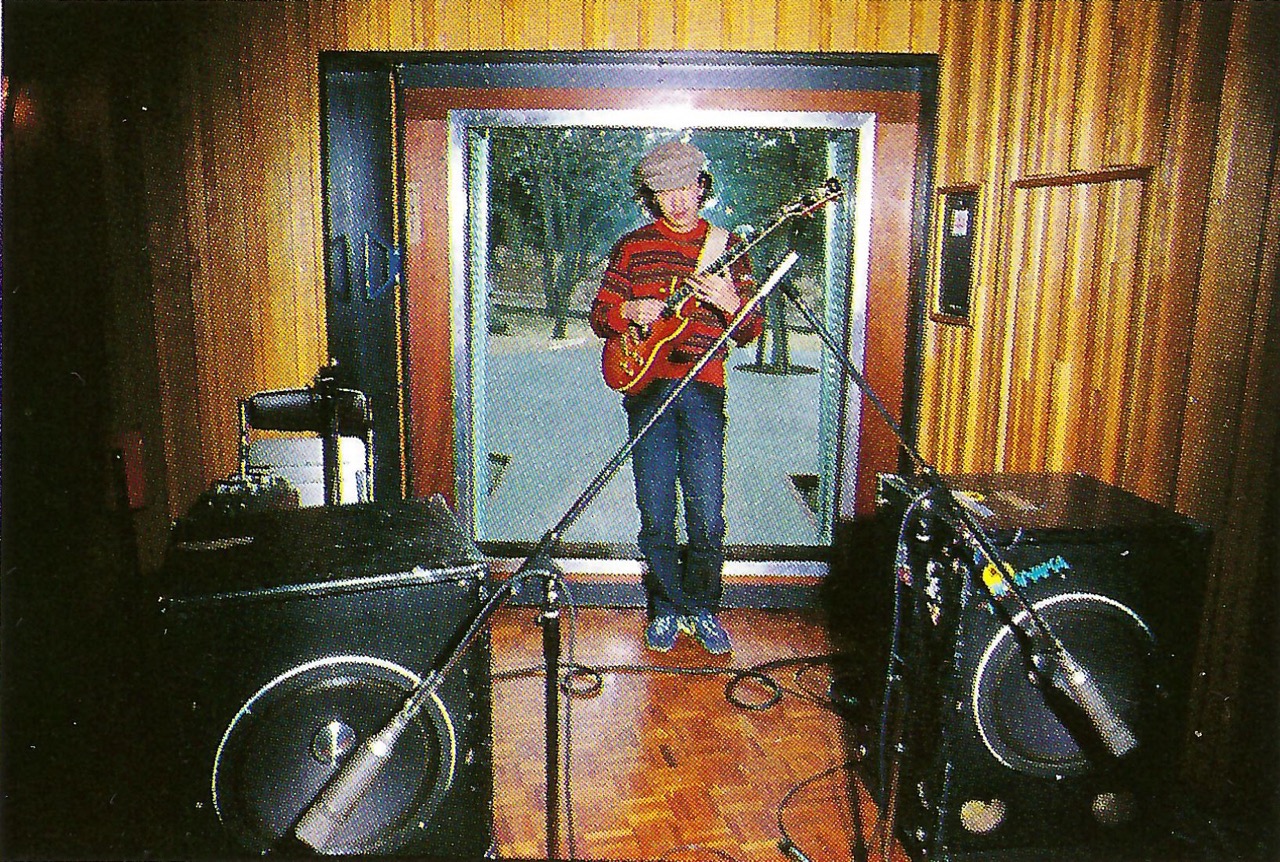
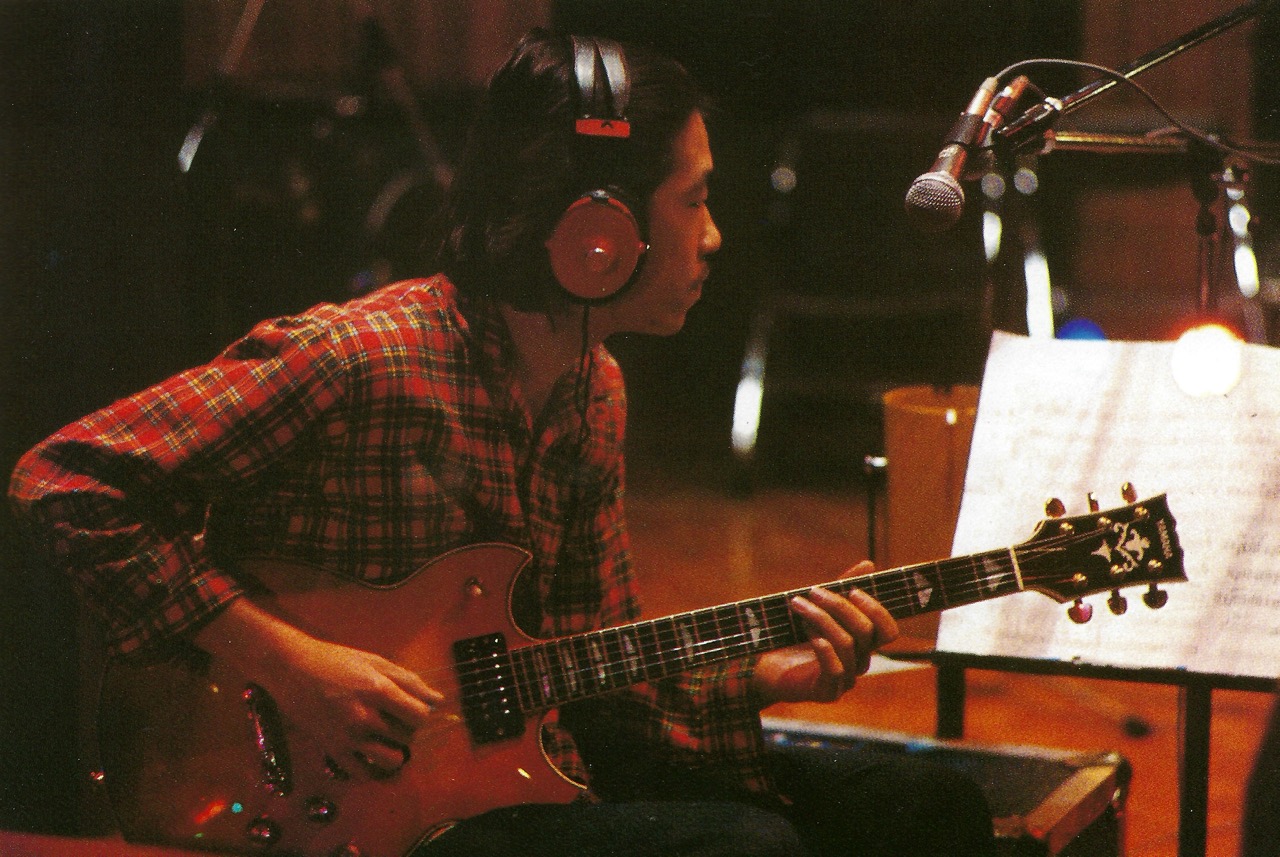
It was with these new humbuckers that Takanaka used this guitar to record the iconic "THE RAINBOW GOBLINS" studio album. Funnily, the rainbow guitar he used for the legendary Budokan live performance of the album was also a red sunburst SG1000. This time a 1979 model with Greco Dry Z humbucker pickups installed (PAF type clones), more on this guitar in a future article.
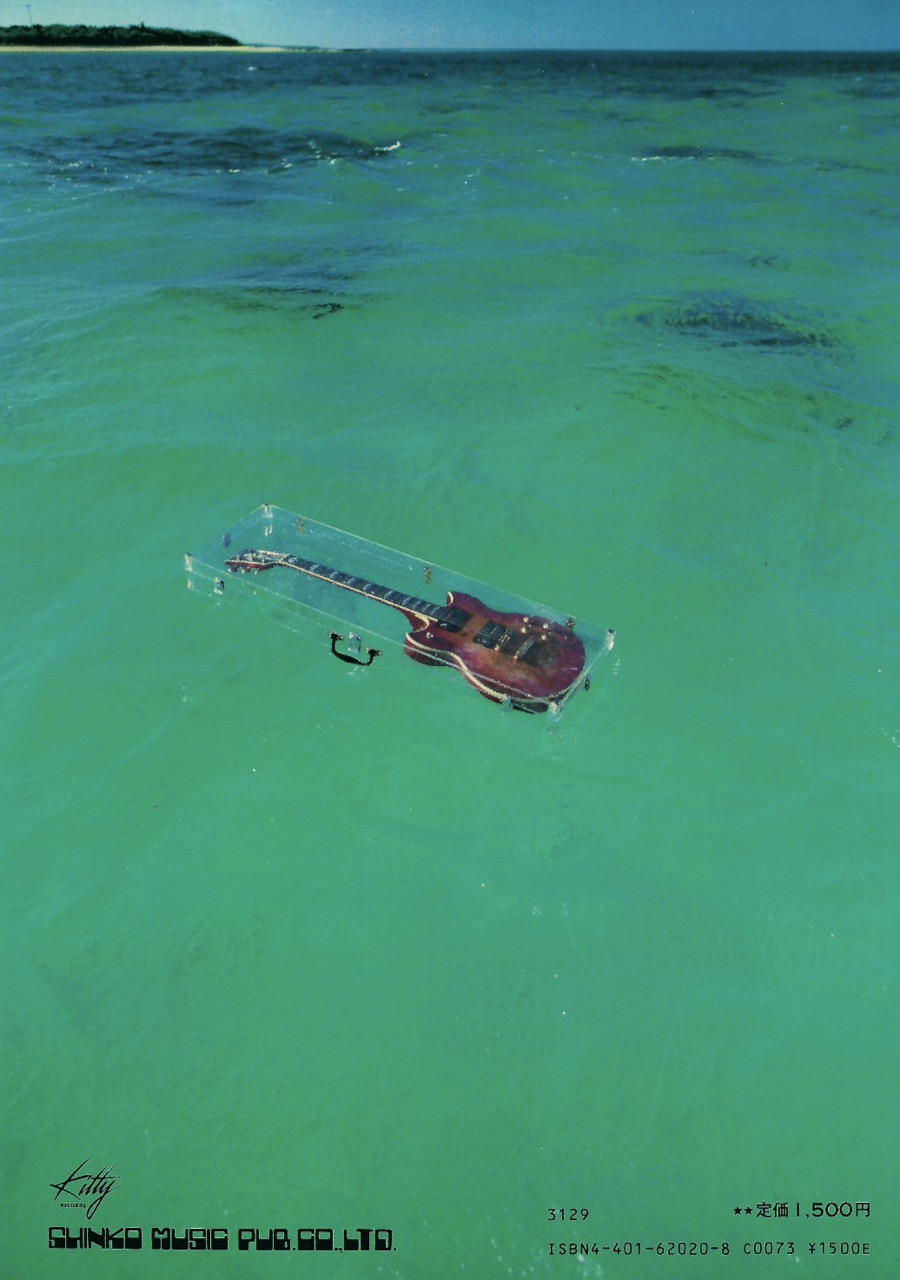
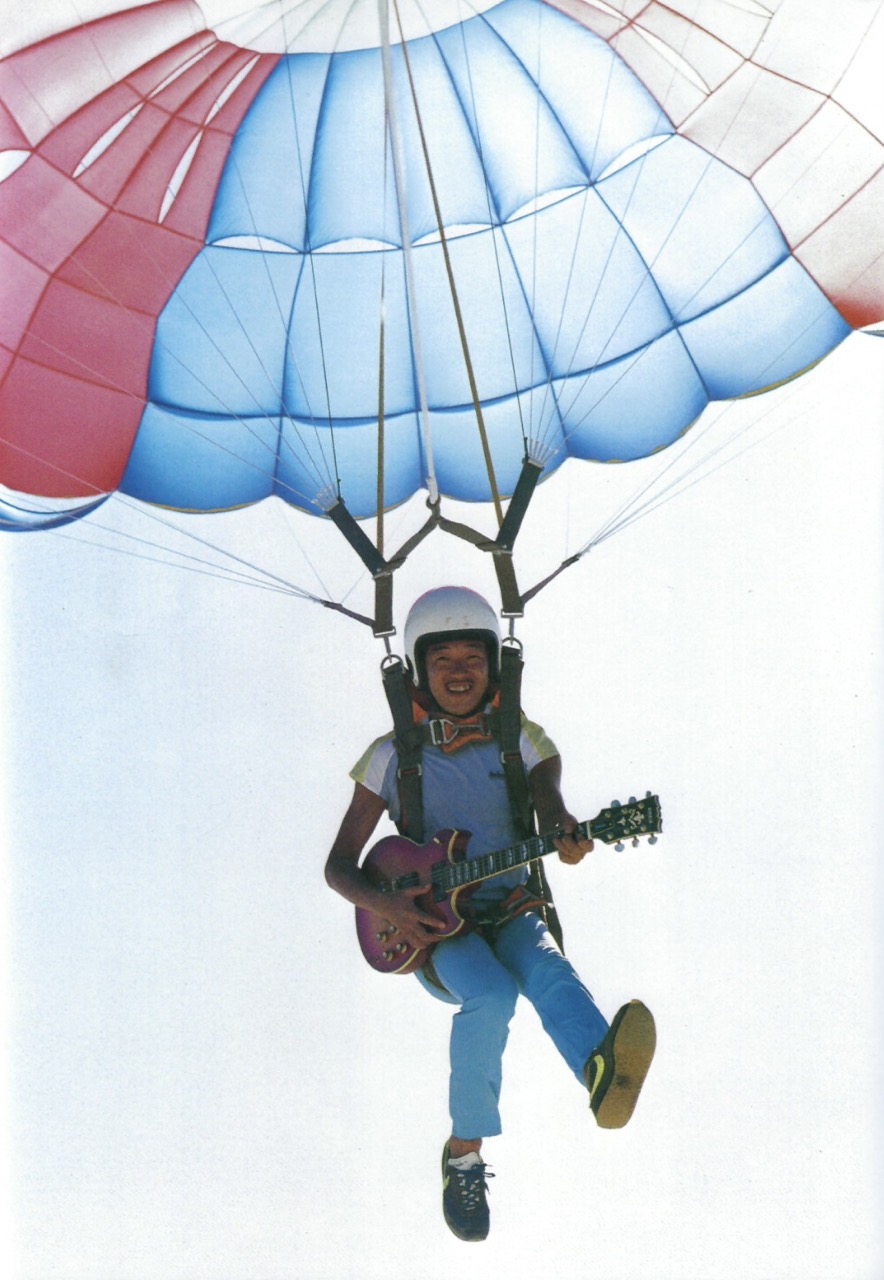
After giving the guitar away in 1995, Takanaka reached out and asked to borrow the guitar for his 2010 tour. If you'd like to see it in action check out the "Takanaka Super Live 2010" performance on YouTube, around the 44 minute mark. The guitar was then returned after the tour. This performance is particularly moving as Takanaka's very good friend, and Sadistic Mika Band bandmate, Kazuhiko Katō took his own life the year prior. You can see Takanaka's tribute to Katō around the 21 minute mark of the performance.
As of July 2026, the guitar is still in the possession of Kstudio on loan from the owner Mr Goro. Kstudio has carried out some basic maintenance on the guitar and has preserved its original condition.
As research continues the information on this page may be updated.